Wilderness refuelling

Posted in Intercept, Rules, Traveller on May 29, 2010 by Mr Backman

The assault scout Anacron have detected the gravity waves of a large fleet of Zhodani warships entering the system, they must leave the system and warn the navy of the impending attack.

“We need jump fuel to flee the system before the Zhodani fleet arrives, what options do we have?”

“We could skim the gasgiant but the Zhos will certainly picket the gasgiant”

“We could match course with a comet and do some ice mining”

“We could land on the outermost moon of the gasgiant and fill up on methane”

“Set course for the outermost moon of the gasgiant then, make sure the moon is between us and the gasgiant as we approach. We don’t want the Zhos catching us on the planet”

“Roger that Sir”

This post has been updated 2018-07-12 to reflect changes in the rules.
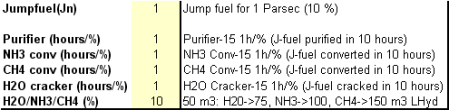
I have recently added som new fuel options to the Intercept design system and some explanations might be in order. These refuelling options does not affect the combat capabilities of a ship so those who use Intercept strictly for battles may want to skip. The new design system is available here.

Hydrogen fuel
Ships use fuel for two things; reaction mass for rockets and jumpfuel, the hydrogen must in both cases come in the form of liquid hydrogen or LHyd.

The fuel used by the fission or fusion powerplant of the ship will not be considered here as it is built into the powerplants and will keep the powerplant running for a year (6 months for fission) before replacement. Powerplants need this ‘refuelling’ regardless of whether they are run or not. Both fission and fusion plants have fuel that decay over time and this decay make the fuel less efficient and harder to ‘burn’ (Tritium for fusion plants, Uranium or similar for fission plants). Carrying extra fuel wouldn’t help either as that fuel would decay as well. Fusion powerplant refuelling is covered by the annual maintenance fee.

Liquid hydrogen has a density of less than 10% that of water and as volume is at a premium on starships, a lot of effort has been spent on how to increase the density of hydrogen storage. Hydrogen also happens to be the most common element of the Universe, there is plenty of hydrogen in water, ammonia and methane, in fact there is more hydrogen per cubic meter of those substances than there is in pure liquid hydrogen, these compounds are also very common on planets, rings, comets and asteroids. These two facts have led to the development of a number of alternative fuel storage technologies.

Hydrogen storage
A ship can store hydrogen in four different forms:

  • Liquid hydrogen or LHyd is the only form useable by jumpdrives or reaction engines, all other forms must be converted into LHyd before use. Jumpdrives are very sensitive to impurities in the fuel so a ship using wilderness fuel can add a fuel purifier to filter out Deuterium, Tritium, helium and other impurities from the jumpfuel. There is no need to purify reaction mass.
  • Water or H2O holds 50% more hydrogen than LHyd but is ten times as dense. Water must be processed by a water cracker before it can be used as jumpfuel or reaction mass.
  • Ammonia or NH3 holds twice as much hydrogen as LHyd and has the same density as water. Ammonia must be processed by a NH3/CH4-converter before it can be used as jumpfuel or reaction mass, this converter work for both ammonia and methane but not for cracking water.
  • Methane or CH4 holds three times as much hydrogen as LHyd and has the same density as water. Methane must be processed by a NH3/CH4-converter before it can be used as jumpfuel or reaction mass, this converter work for both ammonia and methane but not for cracking water.

Water crackers ammonia converter and methane converters are rated in hours per hull percentage converted, this is the output percentage and not the input. A 1 hour per % water cracker would convert 0.67% of water into 1% of LHyd per hour, an equally rated ammonia converter would convert 0.5% ammonia into 1% LHyd per hour  and the methane converter would convert 0.33% of methane into 1% LHyd. The fuel purifier mentioned above, is also rated in hours per fuel percent purified.

Tanks and converters
Aside from reaction mass and jumpfuel you can add tankage for water/ammonia/methane, this tankage cannot be used directly, it needs to be converted into LHyd by an appropriate converter (NH3 converter, CH4 converter or H2O cracker).

Add a purifier if you want your LHyd clean and free of impurities. The purifier removes any Deuterium, Tritium, Helium or other traces from the LHyd, purifying your jumpfuel decreases the risk of misjumps and J-drive damage when using wilderness fuel. Some starports sell unpurified LHyd at a lower price.

Add fuelscoops to your ship if you want to skim gas giants for hydrogen, adding the aforementioned purifier will help you filter out the impurities from gasgiants. Note that not all gasgiants give you hydrogen when skimming, some will give you ammonia instead. The fuelscoops will convert your fission and fusion rockets into air breathers which will reduce fuel use and lessen radioactive waste when flying in an atmosphere.

Fuel skimming in Intercept
Skimming fuel from gasgiants is probably the most dangerous form of wilderness refuelling, how dangerous is up to each referee using whatever rules system he prefers. If you want to do fuel skimming during an Intercept battle you can use these rules:
Fuel skimming consists of repeatedly performing aerobrake manuevers on a gasgiant. As gasgiants are huge planets all skimming should be done with the large-scale rules (1 square equals 100 000 km, one turn equals one hour). How much fuel you get from each aerobrake pass depends on your speed prior to aerobraking; you get 20% fuel per brake G. Roll for aerobrake damage as outlined in the Intercept rulebook. If the ship is stationary in a gasgiant voluntary aerobrake square it can skim 5%.

Example The 60 000 dTom Azhanti High Lightning cruiser relies on its fuel shuttles for gasgiant skimming but in an emergency it can perform the skimming itself, at quite some risk. The hull of the Azhanti has a safe speed of 0.5 for aerobraking so each point of speeds adds +2 on its aerobraking damage rolls. Skimming at speed 1 down to 0 would give it 20% fuel per pass, three such passes and it will have replenished its jumpfuel. Each pass the Azhanti must roll at +2 for hull damage on the damage table ie a 4+ would cause Light hull damage. Yes, only in extreme emergencies will the Azhanti do the skimming on its own. You may wonder why they didn’t simply give the Azhanti Streamlined or better hull and the answer would be surface area. A warship needs lots of surface area to mount all their weapons and sensors. Tradeoffs I keep telling you, tradeoffs.

Relativistic rocks don’t kill people – People with relativistic rocks kill people.
Gravity in boardgames

Posted in Boardgames, Design system, Intercept, Other vector movemet systems, Scenarios on May 13, 2010 by Mr Backman


Introduction

Space combat games are typically played on black hexgrids with no terrain features at all. Some games add asteroid fields, planets, nebulas, electric storms etc and some even try to incorporate the gravity field around planets. This is at least something we know, real planets do have gravity fields around them and climbing up the gravity well takes serious effort; just look at how big the Saturn V needed to be in order to send three guys to the moon and back.

What can we say about gravity then? Well, it pulls you back toward planets, a ship can remain indefinitely in orbit without thrusting, the higher above the planet a ship orbits the longer it takes; 1.5 hours in low orbit, 24 hours in Clarke orbit and a whole month per lap when you are as far away as the moon. We also know that if a ship has enough speed it can escape the gravity of a planet, this speed is called escape velocity for obvious reasons. Orbits don’t have to be circular either, they can be elliptical with one part getting real close to the planet and the other part taking it back further out, these orbits are also stable and require no thrust to maintain.

Prior examples

The first boardgame I came across that used vector movement was also the first that tried to depict gravity in a sensible manner, that game was Mayday. Mayday borrowed its gravity rules from Triplanetary and the mechanics where simple: If your vector, including its endpoint but excluding its startpoint, intersected one or more hex adjacent to a planet its future position would be affected. Another game with gravity rules was a game called Orbit war that was published in the Space gamer and then became a full blown boardgame.

Intercept version

In Intercept we want to do more than just being in orbit or not. Having several stable orbits with different periods allow us to model low tech orbital warfare with limited endurance fission/fusion rockets and spotting limited by the horizon. We can do elliptical orbits but that is something that just happen to work, free chrome one could say.

How do you do gravity in Intercept then? If your ship is inside a planet’s gravity well (6 squares for Earth) check what arc of the
planet you are in and adjust your drift in the direction of your current position towards the planet. Yes, gravity pull is based on the
position of your ship versus the planet but applied on the drift of your ship. If your ship is on the planet itself you do not adjust for
gravity (what direction would that be?).

That is all folks; if the ship is inside the gravity well but not on the planet you note the direction towards the planet and move your drift in that direction.

Scenario: Fission duel

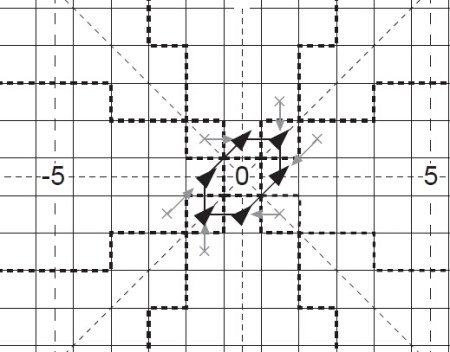
This is a simple scenario with two equal ships battling it out in orbit above a planet. the ships start in the same orbit on opposite sides of the planet knowing where the opponent is but they cannot track him because the planet blocks LOS. The ships are 1G fission thrusters with 8 turns of thrust endurance and they are armed with a single small missile turret. You must carefully maneuver your ship close enough for your missiles 2G range single turn range. The ship has a crew of two; 1 pilot and 1 gunner/sensor op, there is no repair crew so there can be no repairs. Use the orbit from the image, ship A starts at x=0, y=-1, ship B starts at x=0, y=1 with the drift positions as shown. As I said earlier, this scenario is especially suited for deterministic play.

Gentlemen, start your fission drives, let the duel commence!

Major victory: Your opponent is a mission kill (incapable of firing and incapable of maneuvering) and you manage to land on the planet.

Minor victory: Your opponent is a mission kill and you are not.

Draw: Both ships incapable of maneuvering  and in such orbits that they will never get within 2G of a missile shot.

Make your own TL 8 Fission thruster equipped ships, equal or custom designed by each player. 100 MCr each is my suggestion for price.

Intercept bundle update

Posted in Design system, Intercept, Rules on April 29, 2010 by Mr Backman

I have made some changes to the rules, mostly regarding Sensors. There were also some changes to the missiles, especially the larger ones. These changes are in the new rulebook as well as the new Data.xls file. Just replace your old Data.xls with the new one and all your designs will be updated. You can download the Intercept bundle here. Sensors had some changes in terminology and how radar works, the integration bonus rule also changed. Missiles now have a -2G penalty for being cold launch instead of the -1 before, and the larger missiles endurance was reduced, the missiles also got longer control range to fit the range bands. The initiative rules was cleared up a bit and a tie breaker for better control stations was added (Bridge stations > Full stations > Limited stations, mostly to rationalise why warships have such large bridges).

I have not made any changes to Ship.xls as such updates are more troublesome for my users. When I get around to it I will add a Very large turret option (taking x10 the Large turret of weapons) and adding a Very small laser of 5 MW mainly for use as point defense against missiles. I should also do something about fuel purifier, skimmer, cracker, and methane converters. These babies would allow a ship to store liquid Ammonia or Methane instead of the usual liquid Hydrogen to pack more fuel per m3. The drawback would be that you must convert it into hydrogen before you can use it for the jump drive. My take on the mysterious Fuel purifier is that Jump drives use hydrogen not as fuel but as matter to build up the jump field, and that Hydrogen that has been purified from Deuterium and traces Helium etc work better. Finally, I should also add some kind of energy storage banks so you can build ships that must power up their banks before they can fire, Attack vector style.

If someone wants anything added, changed or explained please use the Comment feature, I will gladly answer any questions regarding Intercept, I am a bit surprised about the lack of comments given the number of downloads and views. Come on guys and girls, don’t be shy.

Move along, there is nothing interesting here. I am a perfectly normal human worm-baby.

Intercept summary

Posted in Intercept, Rules on April 26, 2010 by Mr Backman

On the surface, Intercept is nothing more than the old game Battleships with vector movement. You take turns asking your opponent if he is In a certain area of the map while moving around with your ship. If you spot him you have one turn of attacks with impunity and then he’ll know where you are turning the game into a dogfight.

Moving your ship is governed by something called vector movement which may take some time to get the hang of. Count out your last move again and mark that square as your Drift position, this is where you will end up if you don’t thrust. Your ship has the same nose direction as your last turn (it does not need to coincide with the direction you travel). From your drift position you turn your ship to the direction you want to thrust (the ships size determine how much you can turn each turn) and then apply thrust. This is your ships new position and it will form the basis for your next turns drift. Easy.

If one or more targets are Spotted there might be combat but early in the game, before any Spotting,  movement is typically directly followed by Sensors. Using sensors simply consist of you choosing a square area on the map that your ship can see and ask your opponent if you see anything. Odd turns you do it first and on even turns he do it first. You tell him the location, radius, Effect and type that your opponent should check against. If his ship is outside the area he tells you nothing (after a suitable pause) but if his ship is inside the area he must check for detection. He adds your Scan (Sensor + Scan radius modifier) to his Signature (based on his ship data) to get the Signal.

Scan = Sensor + Scan radius modifier (calculated by senser)

Signal = Scan+ Signature (calculated by target)

  • A Signal of less than 0 means you see nothing
  • A Signal of 0-2 means Noticed (you know something is out there but not what or where)
  • A Signal of 3-5 means Detected (you know where it is but you cannot track or shoot it)
  • Signal of 6+ means that the target is Spotted. Spotted means the target must, from now on, do its movement before unspotted ships and in plain sight on the common map, it also means that you can attack it.

Spotted is lost only when none of your ships have Line Of Sight to the Spotted target. Before anyone gets Spotted you plot your movement in secret and take turns sensing first or last. When someone is Spotted we use the Initiative rules to determine in what order things should be done in. This is really important in Intercept because attacks and damage take effect directly – shoot someone and he may never be able to shoot back. Spotted ships have lowest Initiative, ties are broken by lowest turn value. High initiative moves last and attacks first given the high initiative ship advantages in both cases.

Combat then. There are two broad classes of weapons in Intercept; beam weapons and missiles. Beam weapons (they all fire pulses despite their name) are lasers, particle beams and so-called meson guns. They all fire pulses of energy in a straight line at or near the speed of light. Missiles on the other hand attack by impacting on the target and inflicting damage from kinetic energy.

Firing beam weapons at a target is done by rolling 2D6 vs a number based on range, target size and various other factors. The degree that the roll succeeded is called the Hitmargin and affects defensive systems, armor penetration and damage.

  • A Hitmargin of less than 0 means you missed the target, no effect.
  • A Hitmargin of 0-2 is a Fair hit. Roll Penetration and Damage with lowest of 2D6, hitlocation is random.
  • A Hitmargin of 3-5 is a Good hit. Roll 1D6 for penetration and Damage and the attack arc determines the hitlocation.
  • A Hitmargin of 6+ is a Very Good hit. Penetration and Damage use the highest of 2D6 and the attacker can choose the hitlocation.

All beam attacks, whether they hit or not, automatically have you Spotted by the target. The attacker rolls his attack rolls and note the Hitmargin, the defender then roll defense rolls if any and his result will reduce the hitmargin of the attack. If the defense get equal or better degree of success (Fair, Good or VGood) than the attacker the attack is stopped, otherwise the attack continues to Penetration and Damage.

Missile attacks must maneuver the missile onto the target location (missiles move after all ships) and then roll to find a hit margin as above. Defenses will try to beat that Degree of success to avert the missile attack but if they fail, Penetration and Damage are rolled for in the same manner as for beam weapons. Missiles have their PEN and DAM affected by the relative vector versus the target; high relative speed and it is harder to hit, harder to defend against, will penetrate better and do more damage, the opposite is also true.

For Penetration one compares the PEN of the weapon versus the ARM of the target to get a number that must be equal or better on a die roll (use the best of 1D6 or 2D6 depending on Degree of success). If the attack penetrated we roll for damage by comparing the weapon DAM versus the DAB of the target. You get a basic damage level and a number that must be equal or better on a die roll (use the best of 1D6 or 2D6 depending on Degree of success). The result is one of the damage levels

  • None Target location is unaffected
  • Light Target location is lightly damaged, generally suffering a -1 to values or die rolls.
  • Severe Target location is severely damaged, generally suffering a -3 to values or die rolls.
  • Critical Target location is critically damaged, generally no longer useable but still repairable.
  • Destroyed Target location is destroyed and cannot be repaired. Destroyed Hull hits destroy the target utterly, destroyed results elsewhere give an additional damage roll for a Hull hit.

Any damage result above None remove the jury rig repairs of the location, if any. Use the highest damage level of the attack and the current level. A new damage of equal level increases damage one step.

  • No damage No effect and keep jury rigs
  • New damage lower Keep previous damage, jury rigs lost.
  • New damage equal Damage become one level higher and all jury rigs are lost.
  • New damage higher Use new the damage, all jury rigs are lost.

Well, this is basically what Intercept is with all the detail removed. Intercept also has its own design system so you can build your own ships at various tech levels to see if your theories on the ultimate design bears out in practice.

Relativistic effects are the Universe’s apology for setting the lightspeed too low.