Archive for the Rules Category

Intercept summary

Posted in Intercept, Rules on April 26, 2010 by Mr Backman

On the surface, Intercept is nothing more than the old game Battleships with vector movement. You take turns asking your opponent if he is In a certain area of the map while moving around with your ship. If you spot him you have one turn of attacks with impunity and then he’ll know where you are turning the game into a dogfight.

Moving your ship is governed by something called vector movement which may take some time to get the hang of. Count out your last move again and mark that square as your Drift position, this is where you will end up if you don’t thrust. Your ship has the same nose direction as your last turn (it does not need to coincide with the direction you travel). From your drift position you turn your ship to the direction you want to thrust (the ships size determine how much you can turn each turn) and then apply thrust. This is your ships new position and it will form the basis for your next turns drift. Easy.

If one or more targets are Spotted there might be combat but early in the game, before any Spotting,  movement is typically directly followed by Sensors. Using sensors simply consist of you choosing a square area on the map that your ship can see and ask your opponent if you see anything. Odd turns you do it first and on even turns he do it first. You tell him the location, radius, Effect and type that your opponent should check against. If his ship is outside the area he tells you nothing (after a suitable pause) but if his ship is inside the area he must check for detection. He adds your Scan (Sensor + Scan radius modifier) to his Signature (based on his ship data) to get the Signal.

Scan = Sensor + Scan radius modifier (calculated by senser)

Signal = Scan+ Signature (calculated by target)

  • A Signal of less than 0 means you see nothing
  • A Signal of 0-2 means Noticed (you know something is out there but not what or where)
  • A Signal of 3-5 means Detected (you know where it is but you cannot track or shoot it)
  • Signal of 6+ means that the target is Spotted. Spotted means the target must, from now on, do its movement before unspotted ships and in plain sight on the common map, it also means that you can attack it.

Spotted is lost only when none of your ships have Line Of Sight to the Spotted target. Before anyone gets Spotted you plot your movement in secret and take turns sensing first or last. When someone is Spotted we use the Initiative rules to determine in what order things should be done in. This is really important in Intercept because attacks and damage take effect directly – shoot someone and he may never be able to shoot back. Spotted ships have lowest Initiative, ties are broken by lowest turn value. High initiative moves last and attacks first given the high initiative ship advantages in both cases.

Combat then. There are two broad classes of weapons in Intercept; beam weapons and missiles. Beam weapons (they all fire pulses despite their name) are lasers, particle beams and so-called meson guns. They all fire pulses of energy in a straight line at or near the speed of light. Missiles on the other hand attack by impacting on the target and inflicting damage from kinetic energy.

Firing beam weapons at a target is done by rolling 2D6 vs a number based on range, target size and various other factors. The degree that the roll succeeded is called the Hitmargin and affects defensive systems, armor penetration and damage.

  • A Hitmargin of less than 0 means you missed the target, no effect.
  • A Hitmargin of 0-2 is a Fair hit. Roll Penetration and Damage with lowest of 2D6, hitlocation is random.
  • A Hitmargin of 3-5 is a Good hit. Roll 1D6 for penetration and Damage and the attack arc determines the hitlocation.
  • A Hitmargin of 6+ is a Very Good hit. Penetration and Damage use the highest of 2D6 and the attacker can choose the hitlocation.

All beam attacks, whether they hit or not, automatically have you Spotted by the target. The attacker rolls his attack rolls and note the Hitmargin, the defender then roll defense rolls if any and his result will reduce the hitmargin of the attack. If the defense get equal or better degree of success (Fair, Good or VGood) than the attacker the attack is stopped, otherwise the attack continues to Penetration and Damage.

Missile attacks must maneuver the missile onto the target location (missiles move after all ships) and then roll to find a hit margin as above. Defenses will try to beat that Degree of success to avert the missile attack but if they fail, Penetration and Damage are rolled for in the same manner as for beam weapons. Missiles have their PEN and DAM affected by the relative vector versus the target; high relative speed and it is harder to hit, harder to defend against, will penetrate better and do more damage, the opposite is also true.

For Penetration one compares the PEN of the weapon versus the ARM of the target to get a number that must be equal or better on a die roll (use the best of 1D6 or 2D6 depending on Degree of success). If the attack penetrated we roll for damage by comparing the weapon DAM versus the DAB of the target. You get a basic damage level and a number that must be equal or better on a die roll (use the best of 1D6 or 2D6 depending on Degree of success). The result is one of the damage levels

  • None Target location is unaffected
  • Light Target location is lightly damaged, generally suffering a -1 to values or die rolls.
  • Severe Target location is severely damaged, generally suffering a -3 to values or die rolls.
  • Critical Target location is critically damaged, generally no longer useable but still repairable.
  • Destroyed Target location is destroyed and cannot be repaired. Destroyed Hull hits destroy the target utterly, destroyed results elsewhere give an additional damage roll for a Hull hit.

Any damage result above None remove the jury rig repairs of the location, if any. Use the highest damage level of the attack and the current level. A new damage of equal level increases damage one step.

  • No damage No effect and keep jury rigs
  • New damage lower Keep previous damage, jury rigs lost.
  • New damage equal Damage become one level higher and all jury rigs are lost.
  • New damage higher Use new the damage, all jury rigs are lost.

Well, this is basically what Intercept is with all the detail removed. Intercept also has its own design system so you can build your own ships at various tech levels to see if your theories on the ultimate design bears out in practice.

Relativistic effects are the Universe’s apology for setting the lightspeed too low.

Intercept Line-Of-Sight tutorial

Posted in Intercept, Rules, Scenarios on April 17, 2010 by Mr Backman

The rules for Line-Of-Sight (LOS) are important in Intercept as they govern when you can be seen and when you cannot. In this post I’ll do a step by step that deals with planet LOS, aft centerline and the sun direction. I will cover these in detail but I won’t bother with any actual sensor signatures, scan radius etc. The basic assumption here is that your ship is undetectable when drifting and automatically spotted when thrusting unless you happen to be on the enemies aft arc (as the enemy will always be drifting he should in reality be able to trace LOS through his aft centerline), on his sun direction row or have the LOS blocked by the planet.

Situational report

Well, you are the commander of a UFO that has just finished its mission on earth (anal probing, crop circling, abductions, the usual boring mission) and now it is time for you to exit the solar system undetected. Galactic law allows meddling in human affairs as long as you are never spotted by astronauts, astronomers and similar creatures and the problem is that the humans have put up a space station, known to them as ISS, that is filled with just such beings. If your UFO get spotted the galactics will revoke your license and your Emperor will be most unhappy. Luckily enough your UFO is equipped with a stealth device that make it invisible to all sensors when it is not thrusting. When it thrusts though, all that pent-up heat is radiated away and makes your UFO easily detectable even with the puny telescopes of the ISS station.

You will start your mission in the same orbit as the IIS but on the other side of the planet. You are then to cleverly thrust away from Earth until you leave the map area and can engage your warp drive. In Intercept terms you will have a 1G ship with unlimited endurance that can only thrust when the LOS between you and ISS is blocked from Earth, the sun direction or the ISS rear centerline (the ISS should be able to scan the aft centerline as it is never thrusting but the silly humans put their urine and feces ejection system to eject in the aft centerline so no one will use telescopes in that direction, out of modesty.

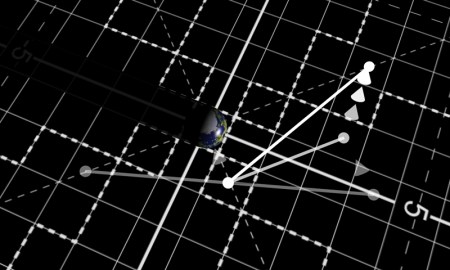
Your UFO is currently 1,0 facing SW and the ISS is in -1,0 facing NE. Your gravity assisted drift will take you to 0,-1 and the ISS will drift t 0,1. You decide to turn your ship three steps right so it will face towards S and you will then thrust 1G so your destination will be 0,-2 facing S. After movement is taken care of we must should look and see if the ISS can see us. It is fairly obvious that the LOS is blocked from the planet but let’s see what the Intercept rules actually say about planet LOS.

Centerline blocks entire opposite arc.
Left half arc blocks opposite right halfarc and opposite centerline.
Right half arc blocks opposite left halfarc and opposite centerline.

ISS is on the N centerline which means LOS is blocked to the entire S arc (and vice versa as we are on the centerline too). Incidentally, we are now in Earth’s shadow our Visual(Hull) sig would be reduced by -6. OK so far so good, let’s see what happens next turn. Drift and gravity will take the ISS to 1,1 and our UFO will have its drift at -1,-3 facing S before we apply thrust. We decide to thrust directly to east to get inside the SW arc.

The ISS is on the NE centerline so the entire SW arc should be blocked because Centerline blocks entire opposite arc. We are in the right SW half arc so the NE centerline should be blocked because Right half arc blocks opposite left halfarc and opposite centerline. Can we keep thrusting with blocked LOS or do we have to drift for the next turn? (keep in mind that our UFO is entirely invisible, very much unlike TOS Romulans whose cloaking device only cloaked vision so the clever mr Kirk could still shoot using his sensors). The ISS will be in the W arc so we’ll do our best to get into the E arc and thanks to gravity we are able to do just that.

As you can see from the image, without gravity our drift would be at the x position and our puny 1G acceleration would never get us into the W arc, thank you mr Newton! ISS is on the E centerline so the entire W arc is blocked, and vice versa. So far so good. In the next turn the ISS will move into the S arc and there is no way that we will be able to get into the N arc with our 1G thrust so we will drift for a couple a couple of turns instead. Note that the Intercept rules dictate that Gravity range = Surface gravity x 6 so the gravity well around Earth is 6 squares, beyond which there is no gravity.

We will not be in an opposite arc of the ISS so let’s drift some more shall we.

When the ISS is in the W arc we should finally be able to do some thrusting to finally break free of Earth’s gravitational hold.

The ISS is finally in the W arc so whatever we do inside the E arc will be our little secret. We turn our UFO around 4 steps and thrust 1G to 7,-3. You should know by now that when the ISS is on an arc centerline the entire opposite arc is blocked for LOS, we just barely made it still inside the E arc. The captain aboard the UFO pats his pilot on the back, careful not to disturb his dflrghm.

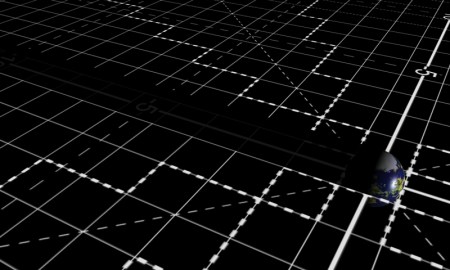
We are now free of Earth’s gravity pull and can just coast all the way off the map where we can engage our warp drive and the pilot can finally jkhdga his dflrghm. Here’s a shot of our UFO three turns from moving off the map, notice how our trajectory no longer curves when drifting as we are no longer subject to gravity.

The entire escape off the map took 17 turns or 4 hours and 15 minutes to use Earth time units. When the UFO got back their homesystem the Emperor was much pleased with the anal probings, crop circlings and abductions, the crew were to keep their heads this time too. During the following photosession a young alien reporter went up to the celebrities and ask them why it took 17 geflerms (4 hours 15 minutes) to escape the planet. The pilot just started to answer when the commander hushed him and said: “Well, because it is impossible to do it faster without becoming detected by the primitives in their space station”

Can YOU do better? Send an e-mail with a turn by turn account for how you would fly the UFO without detection giving the same starting positions and vectors as outlined above. Remember that ISS aft centerline and ISS sun direction also block LOS in this scenario. Write your solution to VectormovementFnordGmail.com (replace the fnord with your favourite cinnamon-bun like character). There may be a price!

May your dflrghm be jkhdga, always!
Intercept rules

Posted in Boardgames, Intercept, Rules, Vector movement on April 2, 2010 by Mr Backman

I finally gotten around to posting my homebrew spacecombat system Intercept. I have been a Traveller gamemaster since around 1980 or so and as my campaigns always have player owned ships there has been quite a lot of space battles. Originally we used the boardgame Mayday for space combat but when the High Guard rules came out we switched to that, mostly for its more detailed ship design system. When GDW released Striker, a wonderful miniature ground combat system with a highly detailed design system for tanks etc, I decided to do my own design system with more depth than High Guard, more along the lines of Striker. High guard based their designs on dTons and Energy Points and but my design system would be built around cubic metres, metric tons, Megawatts and SI units, similar to Striker. I had my own tech progression and added semi-realistic fusion thrusters, semi-realistic sensors, stealth, hydroponic lifesupport, got rid of the silly plasma and fusion weaponry (these may work in an atmosphere but sure as hell not in space) etc etc. It grew over the years to incorporate aircraft, cars, robots, helicopters, submarines, motorbikes, missiles, grav belts etc and eventually became unwieldy, buggy and really hard to maintain.

In 2009 I started fiddling with a new system from scratch, new rules and new design system specifically made to be simpler to use and easier to play (my daughters use it in our Traveller campaign, aged 11 and 15, so it cannot be that hard to use). That is what Intercept 3 is, a space combat system with some simple design rules for spaceships. I may eventually publish the design system in some form, Excel or text or both, but at the moment I will only have ready-made ships and some simple rules for converting whatever ship designs from whatever rules version you have, Traveller or other, into stats for Intercept. There is a table with weapons for small ships that can be used as guides for conversion from existing designs.

Intercept

The rulebook, maps, datacard and the optional transparency are available as pdf files for download. Start out small with one ship each, maybe skipping the Sensor rules out the first times if you are unfamiliar with vector movement. There are no counters in the game as the ships are plotted directly on the map (just print more mapsheets as you need them).

Intercept 3.0 space combat is the main rulebook for the game. The last four pages contain reference tables and should be printed separately and given out to each player. They are organised so they can be printed double-sided as you will never need the information on opposite of a page at the same time.

DataCard is used to fill in gameplay values for your ship, two ships fit on each paper.

Maptemplate is the map used both for the double-blind sensor rules and the actual action when Spotted ship duke it out. Print one for each player and one for the actual combat.

TransparencyTemplate is not strictly needed but helps when plotting sensor scans or determining whether your ship is inside a scan or not. It should be printed on OH film so you can see the map beneath.

You can get the whole shebang including the design system from here.

Initiative in Intercept

Posted in Rules on March 31, 2010 by Mr Backman

Initiative or ‘who goes first’ is very important in Intercept so I will try to explain it in more detail than what the rules does, I will also try to explain why Initiative works the way it does. Highest initiative goes last so you will know your opponents move before you do your own, possibly putting your ship outside of your enemys firing arcs or even on his blind rear line (if he thrusted), highest Initiative shoots first and as damage effects are applied immideatelly you may very well kill or incapacitate your opponent before he gets a chance to retaliate.

The Initiative rules work in three layers that must be checked in order and for the middle layer there are three variants youcan choose to play with depending on personal preference. The first layer forces Spotted ship to do their moves on the common mapboard before the unspotted ships do their move in secrecy. If the unspotted ships decide to attack they will be Spotted but cannot be attacked this turn, the only exceptions to this is ships firing meson guns or missile attacks. The second orders movement and attacks to the advantage of smaller ships. The roleplaying variant of this adds more randomness and the deterministic version adds a tactical element to win the Initiative. The last layer handles tie breakers with skills levels of the commanders.

Unspotted ships have higher initiative

This is the first and primary Initiative rule. Regardless of other circumstances you must move first and attack last if your ship is Spotted.

Spotted ships have Initiative based on turn steps

  • In Roleplaying Initiative you roll dice to see how many turn steps you get, highest turn steps win Initiative.
  • In Size table Initiative determine turn steps from a table based on ship Size, highest turn steps win Initiative.
  • In Deterministic Initiative you read turn steps off a table based on Size and then choose to skip any number of the steps, highest skipped turn steps win Initiative.

Ties in turn steps/skipped steps are done be checking tiebreakers in order

  1. Highest Ship tactics wins initiative.
  2. Highest Fleet tactics wins Initiative.
  3. Highest crew station wins initiative (Bridge > Full > Limited)
  4. Side A wins on even turns, side B on odd turns.

Turn steps

The three ways to determine Turn steps Initiative may seem confusing at first but as Intercept can be used for very different engagements each system has its strength and weaknesses.

Roleplaying initiative let die rolls determine initiative. Each pilot rolls the ship Size or better on 2D6 + skill and the degree of success determines the number of turns allowed and this is also the initiative where higher number of turns have higher initiative (meaning the move last and attack first). This system is for those playing out roleplaying space fights where the player characters control one or more ships. To ease the burden on the referee one can use the Size table system for the NPC ships.

The Size table Initiative read the number of turn steps each turn based on the Size of the ship. It is highly recommended to use the optional table with varying turn steps for the four turns. This helps differentiate ships that only differ by 1 in Size and also give an actual result on turn steps for Hull and Crew hitlocation battle damage. This system is quick and easy for large engagements and leaves no room for chance regarding Initiative.

The final Initiative system is described in the deterministic rules but can be used regardless of how much other deterministic rules you decide to use. The rules use the Size table to get the number of turn steps but instead of directly determine initiative each ship decides the number of turn steps to skip. The number skipped cannot be used for anything besides initiative, they reduce the number of turn steps you may later use for turning or rolling. Highest number of skipped steps wins the initiative. This add a new component to initiative as ships that are already lined up right from the last turn can spend more on skipping and thus get better initiative.