
Hyperspace
Hyperspace is so central to Traveller that one wonders why there is so little hard ‘facts’ about it. I will give my take on how hyperspace and hyperjumps work as well as the reasons why I choose to do it this way.
The main reason for having a detailed explanation how jumping works has to do with roleplaying in general. In actual roleplaying situations the GM must come up with consistent answers to ‘What if someone shuts down the jumpdrive when already in hyperspace?’, ‘How can a ship jump at all as it is inside the 100 d limit of our galaxy?’, ‘If drop tanks are ejected prior to jump, doesn’t that mean that jumdrives consume its fuel prior to entering jump?’, ‘Is jumpfuel burned as normal fuel similarly to a fusion plant?’, ‘Why does a jump take exactly one week?’, ‘What purpose serve the jump-dimming when the lighting power-draw is insignificant to what a typical starship use?’, ‘Can you detect a ship exiting hyperspace?’ etc.
Another consideration is the health of the player characters. We want hyperspace to work in such a way as to not needlessly kill off the characters. If any malfunction of a jumpdrive while in hyperspace results in the guaranteed destruction of the ship we’ll spend a lot more time designing new characters than we really want to. This is probably the most important consideration as long as it doesn’t get too silly; we don’t want all misjumps dropping you into space battles, ancient installations or mother-lode asteroids.
I will refrain from the Trekkie way of inventing new particles, fields and sciences as much as possible and instead try to come up with simple real world explanations, but please note that I do not actually know how jumpdrives work nor how to build one (how could I, Grandfather planted the jumpdrives for each major race to find, nobody but him really invented the jumpdrive).
‘Known facts’
- Traveller books depicts the jumpdrive and hyperspace as something that is not quite understood by scientists, they know how to build a jumpdrive but cannot fully explain how the physics behind them work.
- Jumpdrives punch a hole into another dimension, spend a week there, and return somewhere else, without actually travelling the distance.
- Jumpdrives create a jump-bubble prior to jumping and that bubble surrounds the ship during the jump and isolate it from hyperspace while there.
- Ships require 10% of jumpfuel per jump-number, regardless of tech level. Ships with jumpdrives cannot be made smaller than 100 displacement tonnes.
- Astrogators presumably do their thing in hyperspace, after jumping, as there would otherwise be no need for astrogator crew on X-boats. As X-boats don’t have maneuver drives one could calculate jump from the outside, set the jumpdrive to jump and pick the ship up at the destination, with no need for crew at all.
- Jumping requires energy and this energy must be delivered within a certain timeframe for the jump to work at all.
- If you misjump into a hex (one parsec wide) with a star system you always end up inside the star system (near a planet, gas giant or star). The likelihood of that happening by chance is in reality minimal, so jump exiting somehow tend to occur near masses. Voluntarily jumping to deep space is rare and dangerous, this explains why so few J1 ships have extra jumpfuel and also the importance of the ‘mains’. The fact that ships can cross the great rift tells us that deep space jumping can be done, but only at great risk and effort.
- Some sources say that ships retain their vector relative the planet they jumped from but there is no mention of how the typically huge differences in relative velocity among star systems are handled.
Q: Why does jumpfuel take up 10% per jump number regardless of tech level/ship size and why can you not make smaller jump capable ship than 100 dTon?
A: The jumpdrive uses hydrogen to create a jump bubble around the ship prior to jumping. The jump bubble envelops the entire ship and is created from hydrogen plasma. The thickness of the bubble is proportional to the curvature radius at each point on the surface, the larger the radius the thicker the plasma need to be. When the curvature radius become too small the jump bubble becomes too thin to function properly. Average curvature radius for a ship increases with the scale of the ship while the surface area of the ship increases with the square of the scale. The volume of the jump bubble increases with the scale of the ship as scale x scale^2 = scale^3 or put simpler; the volume of the jump bubble is proportional to volume of the ship. Because of the minimum curvature radius the volume that the jump bubble encompass cannot be too small. Higher jump numbers require higher plasma densities which leads to a corresponding increase in jump fuel requirement.
The above reasoning ‘explains’ why jumpfuel is proportional to ship volume and why there are no ships of less than 100 dTons displacement. If you want to put a jumpdrive inside a 50 dTon ship you still need to give it a J-drive and jump fuel for a 100 dTon ship, to keep the curvature radius above the limit. Instead of forbidding jump ships smaller than 100 dTon they become increasingly expensive. A 50 dTon J-1 ship would need 20% jump fuel per parsec and the J-drive would cost twice as much per ton of ship. The latest Intercept design system incorporates this feature, get it here.
Q: Why is hydrogen used for jump fuel? Do ships really burn all that in a week?
A: Traveller state that only hydrogen will do as jump fuel and should preferably be purified in some manner to work reliably. Sources state that the jump drive is not a fusion reactor so there must be some other quality of hydrogen that is used for the jump fuel. One unique property of hydrogen that no other element has is a perfectly charge-symmetrical nucleus. Add a neutron (as in Deuterium) this symmetry is lost, even more so in Tritium. Elements with more than one proton cannot have a charge symmetrical nucleus, adding neutrons will only make matters worse. Let’s assume that this is what sets hydrogen lacking neutrons the only working element for jump bubble creation. Fuel purification then, is the process of removing hydrogen isotopes as well as any traces of the other elements. Naturally occurring hydrogen has about one Deuterium for every 6000 Hydrogen atoms, enough to destabilize the jumpfield somewhat but not enough to make jumping impossible.
Q: What purpose serves the jump dimming performed during the jump entry? The minuscule draw from ship lighting can be of no consequence to the jump?
A: Jump dimming is often explained that way and yes, it is just a tradition today but the original reason served a purpose once. When the jump-plasma forms it’s emissions are read by sensors on the hull to control its shape. It was once thought that light from windows would distort these readings, so much that the light from a camera flash could cause a ship to misjump. This has since proven to be false but traditions die hard, especially among the superstitious spacer culture.
Q: What happens if you turn off, damage or destroy the jumpdrive while in jump?
A: A misjump is guaranteed as the astrogator will get no readings from the jump-drive when exiting hyperspace but aside from that nothing bad will really happen. The jump drive is actually not used except at jump entry and jump exit, the rest of the time in hyperspace it is shut down. Yes, you can do maintenance on the jump-drive while in hyperspace, if you like to gamble.
Please note that ships in hyperspace do not actually travel during the week, the ‘decision’ on where to exit will be decided by the astrogator during exit. The fact that they do not travel means that jump masking will never occur, if a ship jumps 100 diameters from a planet but 57 diameters from a star the ship is considered jumping from 57 diameters when rolling for entry as well as how far away from the destination it exits. Always use the lowest diameters figure. The ship will ‘pick’ a mass point to exit at, at the same number of radii as when entering hyperspace. If a ship exits into deep space it will enter nearby a comet, asteroid, brown dwarf or even a Pellegrino pancake.
Q: What does hyperspace look like?
A: It is entirely black, zero Kelvin black. The glowing hydrogen plasma jump bubble is left behind in normal space so you see nothing but blackness out there. All this black is a good thing because that means you can radiate heat from your radiators normally even when in hyperspace.
Q: How does droptanks work?
A: Drop tanks tell us that the jump fuel is used up before jumping as the tanks supposedly remain outside the ship and need not be taken into account for jump displacement (according to book 5 High Guard). Jumping also requires a fair amount of energy (also according to book 5 High guard). High Guard states that a computer model equal or above the jump number of the ship is required, this is regardless of astrogator skill. It seems that the astrogator must remain aboard during a jump; if not, there would be much cheaper and more humane to use unmanned X-boats. Below I will outline my ideas on how the process of entering hyperspace works:
The jumpdrive is starting to dump hydrogen plasma to create the jump bubble. This will take anywhere from 15 minutes to 1 hour depending on the power applied. The bubble creation is controlled by the computer, higher jump numbers require faster computers to cope. Any drop tanks are still attached to the ship, they will be jettisoned just moments before the jump.
Q: How much power is needed to jump?
A: As the Jumpdrive itself is not a powerplant it needs external power to operate the plasma that creates the jump bubble. Power consumption and jump prep duration in Intercept is as follows:
Regular 14.5 m3 dTon
- 0.5 EP x Jn / 100 dTon = Enter jump takes 1 hour, which is the longest time and lowest power for a jump to be possible.
- 1 EP x Jn / 100 dTon = Enter jump takes 30 min or two regular Intercept turns.
- 2 EP x Jn / 100 dTon = Enter jump takes 15 min, which is the shortest jump time possible.
Custom 5 m3 dTon
- 12.5 MW x Jn / 500 m3 = Enter jump takes 1 hour, which is the longest time and lowest power for a jump to be possible.
- 25 MW x Jn / 500 m3 = Enter jump takes 30 min or two regular Intercept turns.
- 50 MW x Jn / 500 m3 = Enter jump takes 15 min, which is the shortest jump time possible.
Q: Why is safe jump distance based on planetary diameter?
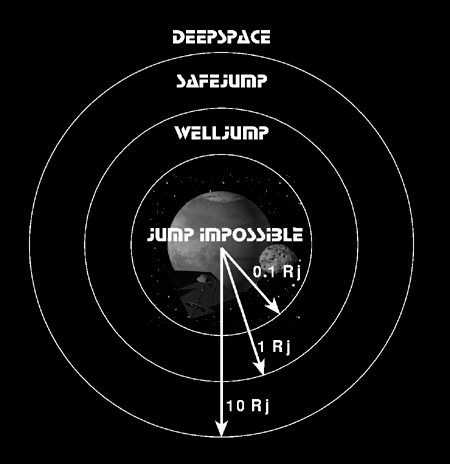
A: Hyper space jumping is affected by the local gravity gradient or in layman terms; how much the gravity changes at the jump point. Change in gravity is called tidal force and happens to fall off at the cube of distance and as mass increases with the cube of planetary diameter the tidal force is proportional to planetary diameter. A more thorough explanation to this can be found here.
Q: Why does misjumps so often end up near planets?
A: Obviously to keep the players entertained but alive. The in-game explanation goes like this:
Hyperspace jumps must be performed inside 1000 planetary diameters and preferably outside 100 planetary diameters. Jump exiting always occurs at the same diameter multiple as the entry. Jump at 57 diameters and you’ll end up at 57 diameters of the target. Entering or exiting hyperspace beyond 1000 diameters is impossible. When a ship is about to exit hyperspace the jumpfield ‘selects’ a mass at least as large as the ship at a distance from the entry based on jump number. The astrogator guides the selection to his intended target at those frantic last minutes prior to exit. Roll astrogation when exiting, not entering hyperspace.
Use whatever method your rule set dictates for determining where you exit but if you should exit an empty hex just decide that the ship exits near a Oort comet, rogue planet, escaped asteroid, brown dwarf etc. This explanation also gives the referee the opportunity to have deep space misjumping players discovering hidden Zhodani fuel caches, derelict spaceships crashed on a comet etc etc.
Q: What is jump masking and how does it work?
A: GURPS Traveller added some rules about how planets and stars 100 diameter sphere would block jump travel. This made calculating jump times more complicated without adding anything to gameplay. It also broke the assumption that hyperspace travel doesn’t propel the ship in our universe; how can a planet or star block a ship that is no longer in our universe? The ship enters hyperspace, stays there for a week and precipitate out at a destination that depends on the astrogator controlling’ the jump drive at the end of the week.
Those who like jump masking can of course use it but I see no point as it breaks the established fiction of hyperspace without giving anything back aside from complication.
Q: Does ships retain their vector when exiting jumpspace?
A referee that allows ships to retain their relative vector when jumping must also account for the relative velocities of the two star systems, and as such velocities are typically very large we get all kinds of problems including perfectly good jumps smashing into planets. We need a system where the ships exit jumpspace at rest visavi the jump target (yes, that means they will eventually fall into the planet if their maneuver drives are dead, X-boat pilots lead interesting lives). The Mach conjecture described below bear little resemblance to the real one posited by Ernst Mach.
Inertial mass is created by the gravity of surrounding matter according to the Mach conjecture. Closer mass has a stronger influence over inertial mass as the mass further away takes longer to ‘react’ to changes in momentum by our ship. The velocity of a ship relative the gravity well it jumps inside is canceled when entering hyperspace, the velocity distributed among the surrounding mass from the Mach wave created by the jumping ship. The Mach wave travels at the speed of light so conservation of momentum is never broken inside the light cone. Ships exiting hyperspace always exit at zero velocity relative the jump target (there are no deep space jumps as explained above).
This may sound as if relative velocity has no significance when entering jumpspace but as the positional uncertainty is larger with higher velocity, hyperspace entry become more difficult in a manner similar to being deeper in the gravity well.
Hyperspace game mechanic sketch
- Travel to somewhere inside 1000 diameters of the planet (ideally one should travel to 100 diameters exactly, closer than that and the entry will be more difficult).
- Spend 15 minutes to 1 hour using up all the jump fuel (from internal tanks or external droptanks), this phase require constant power as explained above.
- Roll a task that depends on Computer, how deep in the gravity well, velocity relative to the central planet, quality of fuel (purified or not), jumpdrive damage. This roll does not depend on the astrogator skill.
- The ship has entered hyperspace, the hyperdrive is switched off and the ship will remain in hyperspace for one week.
- At the end of the week the astrogator must help the jumpdrive ‘select’ a mass to exit at. The difficulty of the astrogator task depends on the result of the jump entry task above.
The ship will always exit at zero relative velocity and at the same number of diameters from a mass-point more massive than the ship itself. It is possible to exit at the entry point, randomly or on purpose. The astrogator decides on the destination at exit, never at entry. Having no astrogator or a broken jumpdrive means the ship will automatically misjump.
Entering hyperspace may very well look like the effect in Star wars, but hyperspace itself is black.

Well, that’s it folks.
Conserve space – dump in jump.


 Vector movement