
The assault scout Anacron have detected the gravity waves of a large fleet of Zhodani warships entering the system, they must leave the system and warn the navy of the impending attack.
“We need jump fuel to flee the system before the Zhodani fleet arrives, what options do we have?”
“We could skim the gasgiant but the Zhos will certainly picket the gasgiant”
“We could match course with a comet and do some ice mining”
“We could land on the outermost moon of the gasgiant and fill up on methane”
“Set course for the outermost moon of the gasgiant then, make sure the moon is between us and the gasgiant as we approach. We don’t want the Zhos catching us on the planet”
“Roger that Sir”
This post has been updated 2018-07-12 to reflect changes in the rules.
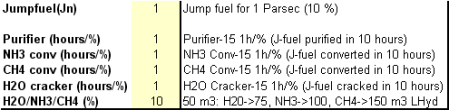
I have recently added som new fuel options to the Intercept design system and some explanations might be in order. These refuelling options does not affect the combat capabilities of a ship so those who use Intercept strictly for battles may want to skip. The new design system is available here.
Hydrogen fuel
Ships use fuel for two things; reaction mass for rockets and jumpfuel, the hydrogen must in both cases come in the form of liquid hydrogen or LHyd.
The fuel used by the fission or fusion powerplant of the ship will not be considered here as it is built into the powerplants and will keep the powerplant running for a year (6 months for fission) before replacement. Powerplants need this ‘refuelling’ regardless of whether they are run or not. Both fission and fusion plants have fuel that decay over time and this decay make the fuel less efficient and harder to ‘burn’ (Tritium for fusion plants, Uranium or similar for fission plants). Carrying extra fuel wouldn’t help either as that fuel would decay as well. Fusion powerplant refuelling is covered by the annual maintenance fee.
Liquid hydrogen has a density of less than 10% that of water and as volume is at a premium on starships, a lot of effort has been spent on how to increase the density of hydrogen storage. Hydrogen also happens to be the most common element of the Universe, there is plenty of hydrogen in water, ammonia and methane, in fact there is more hydrogen per cubic meter of those substances than there is in pure liquid hydrogen, these compounds are also very common on planets, rings, comets and asteroids. These two facts have led to the development of a number of alternative fuel storage technologies.
Hydrogen storage
A ship can store hydrogen in four different forms:
- Liquid hydrogen or LHyd is the only form useable by jumpdrives or reaction engines, all other forms must be converted into LHyd before use. Jumpdrives are very sensitive to impurities in the fuel so a ship using wilderness fuel can add a fuel purifier to filter out Deuterium, Tritium, helium and other impurities from the jumpfuel. There is no need to purify reaction mass.
- Water or H2O holds 50% more hydrogen than LHyd but is ten times as dense. Water must be processed by a water cracker before it can be used as jumpfuel or reaction mass.
- Ammonia or NH3 holds twice as much hydrogen as LHyd and has the same density as water. Ammonia must be processed by a NH3/CH4-converter before it can be used as jumpfuel or reaction mass, this converter work for both ammonia and methane but not for cracking water.
- Methane or CH4 holds three times as much hydrogen as LHyd and has the same density as water. Methane must be processed by a NH3/CH4-converter before it can be used as jumpfuel or reaction mass, this converter work for both ammonia and methane but not for cracking water.
Water crackers ammonia converter and methane converters are rated in hours per hull percentage converted, this is the output percentage and not the input. A 1 hour per % water cracker would convert 0.67% of water into 1% of LHyd per hour, an equally rated ammonia converter would convert 0.5% ammonia into 1% LHyd per hour and the methane converter would convert 0.33% of methane into 1% LHyd. The fuel purifier mentioned above, is also rated in hours per fuel percent purified.
Tanks and converters
Aside from reaction mass and jumpfuel you can add tankage for water/ammonia/methane, this tankage cannot be used directly, it needs to be converted into LHyd by an appropriate converter (NH3 converter, CH4 converter or H2O cracker).
Add a purifier if you want your LHyd clean and free of impurities. The purifier removes any Deuterium, Tritium, Helium or other traces from the LHyd, purifying your jumpfuel decreases the risk of misjumps and J-drive damage when using wilderness fuel. Some starports sell unpurified LHyd at a lower price.
Add fuelscoops to your ship if you want to skim gas giants for hydrogen, adding the aforementioned purifier will help you filter out the impurities from gasgiants. Note that not all gasgiants give you hydrogen when skimming, some will give you ammonia instead. The fuelscoops will convert your fission and fusion rockets into air breathers which will reduce fuel use and lessen radioactive waste when flying in an atmosphere.
Fuel skimming in Intercept
Skimming fuel from gasgiants is probably the most dangerous form of wilderness refuelling, how dangerous is up to each referee using whatever rules system he prefers. If you want to do fuel skimming during an Intercept battle you can use these rules:
Fuel skimming consists of repeatedly performing aerobrake manuevers on a gasgiant. As gasgiants are huge planets all skimming should be done with the large-scale rules (1 square equals 100 000 km, one turn equals one hour). How much fuel you get from each aerobrake pass depends on your speed prior to aerobraking; you get 20% fuel per brake G. Roll for aerobrake damage as outlined in the Intercept rulebook. If the ship is stationary in a gasgiant voluntary aerobrake square it can skim 5%.
Example The 60 000 dTom Azhanti High Lightning cruiser relies on its fuel shuttles for gasgiant skimming but in an emergency it can perform the skimming itself, at quite some risk. The hull of the Azhanti has a safe speed of 0.5 for aerobraking so each point of speeds adds +2 on its aerobraking damage rolls. Skimming at speed 1 down to 0 would give it 20% fuel per pass, three such passes and it will have replenished its jumpfuel. Each pass the Azhanti must roll at +2 for hull damage on the damage table ie a 4+ would cause Light hull damage. Yes, only in extreme emergencies will the Azhanti do the skimming on its own. You may wonder why they didn’t simply give the Azhanti Streamlined or better hull and the answer would be surface area. A warship needs lots of surface area to mount all their weapons and sensors. Tradeoffs I keep telling you, tradeoffs.
Relativistic rocks don’t kill people – People with relativistic rocks kill people.
 Vector movement