Archive for the Rules Category

GURPS Spaceships for Intercept

Posted in Design system, Intercept, Rules on January 13, 2011 by Mr Backman

The GURPS Spaceships design system is a really neat and elegant system and those using it may want to play out battles using my Intercept rules. I am no expert in using GURPS Spaceships so there will be errors in my treatment, please comment or e-mail me so they can be corrected.

Sensors and signatures

GURPS Spaceships (from here on called GS) doesn’t have all the sensor types of Intercept so we must make some assumptions about that. Intercept Visual/IR sensitivity is GS sensor level -6, scientific arrays also have a Neutrino detector at GS sensor level -9 and Tactical arrays have Mass detectors at GS sensor level -10, and yes, the multipurpose arrays includes both of them. Intercept Radar sensitivity is 2 x (GS sensor level -6).

  • Visual / IR scan = GS sensor level -6.
  • Radar scan = 2 x (GS sensor level -6).
  • Neutrino scan = GS sensor level -9 if the ship has a scientific or multipurpose array.
  • Mass scan = GS sensor level -10 if the ship has a tactical or multipurpose array.

Signature modifiers

Use these modifiers when directed to in the text for each signature

  • Stealth sig = 2 x (TL – 6), ignore Chameleon systems.
  • Neutrino stealth = 2 x (TL – 9) if Stealth, ignore Chameleon.
  • Mass stealth = 2 x (TL – 10) if Stealth, ignore Chameleon.
  • Acceleration sig (<1.0G) = -1
  • Acceleration sig (1.0G+) = +0
  • Acceleration sig (3.0G+) = +1
  • Acceleration sig (10.0G+) = +2
  • Powerplant sig (1-2 powerpoints) = -2
  • Powerplant sig (3-9 powerpoints) = -1
  • Powerplant sig (10-29 powerpoints) = +0
  • Powerplant sig (30+ powerpoints) = +1
  • Thrust type sig = Use the GS IR signature modifiers, basically +6 for fission thrust and +8 for fusion thrust (GS page 44-45)

Visual signature

This is the signature from reflected light, either from the central star or from starlight. The central star has a Sun factor of +6 when the ship is in the hospitable zone, +1 for each orbit inwards and -1 for each orbit outwards of the hospitable zone down to a Sun factor of +0. Use the Visual(HullShadow) when the ship is in shadow of a planet.

  • Visual(Hull) = Ship SM – 6 + Sun factor (typically + 6) – Stealth sig
  • Visual(HullShadow) = Ship SM – 6  – Stealth sig
  • Visual(Thrust) = Ship SM + Thrust type sig + Acceleration sig (unaffected by Stealth)

IR signature

The IR signature comes from basic thermal radiation from the hull, the heat from any active powerplants and from reaction engines. The IR(Hull) signature is affected by proximity to the central star as +1 per orbit inside the habitable zone if the ship is not in planetary shadow.

  • IR(Hull) = Ship SM – 6  – Stealth sig +1 per orbit inside habitable zone if not in planetary shadow.
  • IR(Power) = Ship SM + Powerplant sig – Stealth sig
  • IR(Thrust) = Ship SM + Thrust type sig + Acceleration sig (unaffected by Stealth)

Radar signature

The radar signature comes from microwaves or ladar pulses bounced off the hull and back to the sensor. This two-way trip is why the scan size modifiers are doubled for radar.

  • Radar(Hull) = Ship SM – Stealth sig +2 if not streamlined

Neutrino signature

The neutrino signature comes from fission or fusion reactors in the ship or from fission or fusion rockets. GS doesn’t have neutrino stealth so we assume they come with TL 10+ Stealth tech.

  • Neutrino(Power) = Ship SM + Powerplant sig (ignore cosmic powerplants) – Neutrino stealth
  • Neutrino(Thrust) = Ship SM + Thrust type sig + Acceleration sig (unaffected by Stealth) (ignore if chemical, HEDM or electric) (unaffected by Stealth)

Mass signature

The mass signature comes from the ships mass, any operating contragrav lifters, artificial gravity and gravitic compensators. GS doesn’t have mass stealth so we assume they come with TL 11+ Stealth tech.

  • Mass(HullNoFloorfield) = Ship SM – 6 (if no artificial gravity nor gravitic compensators) – Mass stealth
  • Mass(HullFloorfield) = Ship SM (if artificial gravity or gravitic compensators) – Mass stealth
  • Mass(ThrustContragrav) = Ship SM + 6 (unaffected by Stealth)
  • Mass(ThrustReactionless) = Ship SM + 6 + Acceleration sig (unaffected by Stealth)

Movement and performance

Intercept is designed for the ships with 1-6 Gs of acceleration and enough remass to keep accelerating for a couple of hours, solar sail and Ion thruster ship will be sitting ducks in this system.

Combat and damage

One can use the hitlocation and damage rules for GURPS Spaceships as they are and only use the Intercept sensor rules. Fine, go ahead, but those who like the easier to use Intercept version should read on.

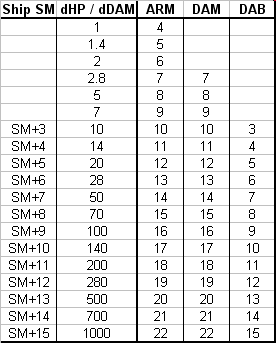
GURPS uses dDam based on square root of energy, dHP based on the square root of mass and dDP based on linear thickness. Intercept uses logarithmic DAM, DAB and ARM so this part needs some heavy converting. I will use the Intercept damage system as it is so much simpler to use so the GS values has to be converted into Intercept values. We know that when at least 10% but less than 50% hull HP is suffered in an attack the hull section is Disabled, if 50% or more is suffered the hull section is destroyed. When the ship as a whole has suffered 200% of original damage it must roll HT to avoid breaking up and if reduced to 600% HP it automatically is destroyed. How do we convert that into Intercept terms?

Let’s say that Critical damage (ie disabled) is at 30% of dHP then all the other damage levels follows as Light damage = 3%, Severe damage = 10% damage, 30% damage = Critical damage and 100% damage = Destroyed. Destroying the entire hull requires 300% damage and we ignore HT altogether. So where will our baseline be, what level of dHP equals DAB 0? To make a long story short I have already had the table in the oven for the customary 90 minutes, I’ll just put on my oven mittens so we can take a look at that freshly baked table.

Use the table below for converting just about everything into Intercept ARM, DAM and DAB. Look up your values in the dHP/dDAM column using the table value that is equal or lower than your GURPS value. Each D6 averages 3.5 which means that 14, 28, 140 etc will be short shifted in rounding so you might consider rounding 14 -> 15, 28 -> 30 etc. Oh, wait. I have a better idea: I fix the table for you!


Weapons

GURPS Spaceships weapons are a bit tricky as they cover such a huge span, even down to the slightly ridiculous shell firing guns. Intercept assumes lasers that  fire tens of thousands of kilometers even for small weaponry while GURPS Spaceships have much smaller ranges (GURPS Spaceships is probably more realistic that way but I needed weapons to fire effectively out to ranges where dodging from  lightlag would come into play).

We assume all 1/2D ranges from GURPS in miles to be ten times that in Intercept, in kilometers, 1000 miles becomes 10 000 km, the 1/2D range is the effective range in Intercept. Calculate the average points of dDam from the weapon (each D6 gives 3.5 points) and look up the corresponding DAM on the table above. GURPS use armor divisors instead of a separate PEN value so we start with a PEN value equal to DAM and then modify according by the armor divisor:

  • Armor divisor 1.5: PEN+1
  • Armor divisor 2: PEN+2
  • Armor divisor 3: PEN+3
  • Armor divisor 5: PEN+4
  • Armor divisor 7: PEN+5
  • Armor divisor 10: PEN+6

Hitlocation

Intercept uses a simple hitlocation system with six locations while GS has three sections with six locations each, plus two core systems added as an obvious fudge to keep each system 5% of hull mass. We will keep the GS hitlocations and add our own rules on how to hit them. In reality we will need two hitlocation systems for GS, one for regular combat and one for the optional deterministic system.

The regular system simply have you roll 1D6 and adjusting what six hull sections can be hit based on the direction of the attack. This is basically the same as in GS with the addition of Front left/right direction with hits half in the Front section and half in the Central section, and the Rear left/right direction where half the hits goes into the Central section and the other half into the rear section. This system makes the top three Front hull systems and the bottom three Rear hull systems less likely to hit.

The Deterministic (diceless) system uses the same tables below but with the following changes:

  • Fair hit The target picks the section among the six eligible from that attack direction.
  • Good hit The attacker picks the section among the six eligible from that attack direction.
  • VGood hit The attacker picks the section among all 20 hitlocations. Yes, he can even choose one of the two [core] sections.

Front

  • 1 Front hull 1
  • 2 Front hull 2
  • 3 Front hull 3
  • 4 Front hull 4
  • 5 Front hull 5
  • 6 Front hull 6

Front Left/Right

  • 1 Front hull 4
  • 2 Front hull 5
  • 3 Front hull 6
  • 4 Central hull 1
  • 5 Central hull 2
  • 6 Central hull 3

Side left/right

  • 1 Central hull 1
  • 2 Central hull 2
  • 3 Central hull 3
  • Central hull 4
  • 5 Central hull 5
  • 6 Central hull 6

Rear left/right

  • 1 Central hull 4
  • 2 Central hull 5
  • 3 Central hull 6
  • 4 Rear hull 1
  • 5 Rear hull 2
  • 6 Rear hull 3

Rear

  • 1 Rear hull 1
  • 2 Rear hull 2
  • 3 Rear hull 3
  • 4 Rear hull 4
  • 5 Rear hull 5
  • 6 Rear hull 6

Miscellanea

Example Star-Flower class Tramp Freighter from GS [TL 11^] The Star flower is a SM +8 design so the ships signatures will be the following:
Visual(Hull) = +8 (SM – 6 + Sun)
Visual(HullShadow) = +2 (SM – 6)
Visual(Thrust) = – (the standard reactionless engines give off no visual signature, except maybe the cheesy blue glow CGI artist add to every ships they lay their hands on)
IR(Hull) = +2 (SM -6)
IR(Power) = +6 (SM -2 for the two power points from the fusion reactor)
IR(Thrust) = – (the standard reactionless engines give off no IR)
Radar(Hull) = +8 (the ship is streamlined so it gets no extra +2)
Neutrino(Power) = +6 (SM -2 for the two power points from the fusion reactor)
Neutrino(Thrust) = – (the standard reactionless engines give off no neutrino signature)
Mass(HullNoFloorfield) = +2 (this is if the ship has its artificial gravity off )
Mass(HullFloorfield) = +8 (this is when the ship has its artificial gravity on)
Mass(Thrust) = +14 (the 2G reactionless drives gives off a strong mass signature)

The ship sensors are as follows:
Visual sensitivity = +4 (GS sensor level 10 – 6)
IR sensitivity = +4 (GS sensor level 10 – 6)
Neutrino sensitivity = – (the ship lacks scientific array)
Mass sensitivity = – (the ship lacks a tactical array)

Next comes the ships sections ARM and DAB and its weapons DAM and Effective range:
Ship ARM  = 9 (dDR of 7 gives us ARM of 9)
Ship DAB = 8 (dHP of 70 gives us a DAB of 8 for the entire ship)
DAM = 11 (we convert the 10 MJ laser turret’s 4D6 to 14 dDam)
PEN = 13 (PEN is the same as DAM modified by the armor divisor of 2 which gives us PEN+2)
Effective range = 1 square (we use the tables in GURPS Spaceships 3 using the 1000 mile column as our 10 000 km).
There is no maximum range in Intercept, the PEN and DAM just go down by -3 for every rangeband beyond effective.

Using Imperial units for Science Fiction is like using Roman numerals for physics. The metric system has been with us since the French revolution, when will you colonials catch on?

Large counters and maps

Posted in Intercept, Rules, Vector movement on October 9, 2010 by Mr Backman

Why has there been no updates you ask? Well I’ve been busy working mostly but I have also spent some time preparing counters for the game.

Large scale maps and counters

When a ship has been spotted in Intercept one can keep playing on the small maps, drawing with pencils as usual but one could also put all the spotted ships onto a larger map with real counters and do the fight there. As the counters depict the position and vector on the map you still get the same feel for how the ships move as on the smaller map. The larger map is split into 9 separate pages to print out, making a 3 x 3 sheet larger map. Each square on the map as well as the counters are 15 mm wide. The map download contains both black space with white lines (better looking) and white space with black lines (saves on toner and ink).

Each ship or missile volley is represented by three counters, Present, Past and Last. One can get away with using only two counters per ship but then you wouldn’t be able to see how much a ship has accelerated by the counters alone and I believe very strongly that as much information as possible should be shown on the map itself

Ship and missile counters; Present, Past and Last

Present represents where your ship is located but also in what direction it faces. It depicts a solid ship or missile volley. The counters are double-sided so one can show that a ship is rolled by flipping its counters over. The Present counter is moved by gravity based on the Past counters position relative to the planet.

Past represents your ship’s position and facing in the last turn. It depicts an outline of a ship or missile volley. The position of the Past counter vs the planet determines how the Present counter will be moved by gravity.

Last represents your ship’s position and facing two turns ago. It depicts a dashed outline of a ship or missile volley.

Last, Past and Present counters moving north

Movement procedure

Movement in Intercept is done in two stages; drift and thrust. First we drift all ships and missile volleys and this can be done in any order as there are no choices to be made. They blindly follow the laws laid out by Mr Isaac Newton. The next step is done in reverse Initiative order with the worst Initiative moving first before the second worst Initiative, and so on until all ships have moved. Missile volleys are then moved but the order which this is done doesn’t matter as missiles cannot attack missiles.

Drift is performed by moving the Last counter to the Past, moving the Past counter to the Present and then finally repeating the Last to Past move again for the Present. If done right the three counters will lie along a line with Past at its center. The final step of the Drift phase is to adjust for gravity. If the Past counter is inside the central planet’s (if any) gravity field note what arc it lies in visavi the planet. Move the Present one square in the same direction, be careful to keep the facing. Do the same for all ships and all missile volleys and then the Drift phase is over.

Thrust is performed in reverse Initiative with lowest Initiative going first. Each ship may turn up to its turn limit and then thrust in the new direction. Rolling the ship costs 4 turn and is shown by flipping the counter over to its Rolled side. Optionally, a ship can turn after thrust but all turns and thrust will then cost double.

Making your own counters

You can download the countersheet here and print it out. The shipcounters with Rolled printed on them should be on the flip side of each ship counter. Missiles don’t roll so they have no flip side artwork. I printed them out on regular paper and the glued them onto cardboard, one can also buy 15 mm octagonal plastic pieces from here and glue the paper counters on, which makes for nice and sturdy counters. I’ll post pictures the plastic ones when I am ready with them. Each ship comes with four volleys of missiles with roman numerals to separate them. You can download the 9 mapsheets here (both the black and the white versions are included) to print out.

In space, nobody can hear you scream – except yourself, really loud, when you scream inside your helmet, and everyone else on your radio channel.

100 diameters limit

Posted in Rules, Science, Science fiction, Traveller on May 30, 2010 by Mr Backman

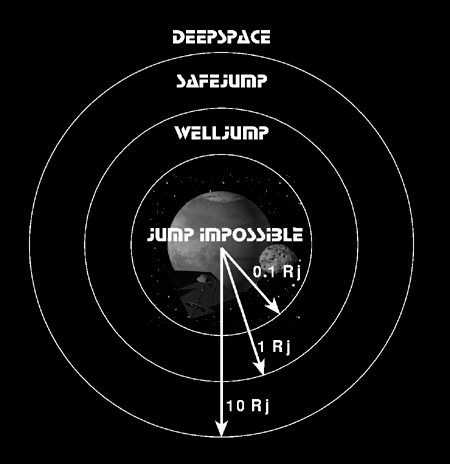
Traveller has always had the rule that hyperspace jumps should be made beyond 100 diameters of the planet, gasgiant, ship, star or nearby massive object. When some kind of reason for this is mentioned it goes along the lines of  ‘too deep within the gravity well’ or other reference to gravity. Can ships jump inside nebulae (they’d certainly be inside 100 diameters of the nebula)? How can ships jump at all when they are always inside 100 diameters of the milky way galaxy? What about jumping near black holes or neutron stars (shouldn’t the density of objects be accounted for at all)?

We all know the real reason is to force ships to actually travel in space before jumping, without such a limit the ships could just as well jump directly from the ground and not much space travelling would occur. So let us all agree that wa want some kind of rule that forces ships to fly away from planets before jumping, preferrable such a rule should behave as the 100 diameter rule for planets yet still make some scientific sense. The rule should also dismiss the cases of nebulae and galaxies so ships can jump inside these while still abiding to the rule. If the rule is based on gravity instead of some weird new invented force all the better.

Gravity then, is proportional to the mass of the object and inversely proportional to the square of the distance. Gravitational force is not the only measure of gravity, we have gravitational potential and tidal force as well. These two are effects derived out of gravity but they behave differently range wise:

  • Gravitational potential falls off as M/R, where M is the mass of the planet and R is the distance from the planet. It is a measure of the energy needed to reach the distance R.
  • Gravitational acceleration falls off as M/R^2, where M is the mass of the planet and R is the distance from the planet. It is a measure of the gravitational acceleration exerted on an object at the distance R.
  • Gravitational tidal force falls off as  M/R^3, where M is the mass of the planet and R is the distance from the planet. It measures the fall-off rate of gravitational acceleration. It is the force that causes ebb and flood on Earth as well as what causes the moon to always show the same face towards Earth.

The mass of a planet is proportional to its volume (given the same density), that means that it rises with D^3. Twice the diameter and the planet becomes 2^3 = 8 times as massive. The 100 diameter rules states that a planet twice as large must be jumped from twice as far away and as mass scales with D^3 we need something that scales as 1/R^3 and the only gravity effect that fit the bill is tidal force. Using tidal force as a limiter for when a safe jump can be performed makes a lot of sense; it is a measure of fast gravity changes near the ship. If jumdrives need a uniform gravity field to work properly the tidal force tells us how much gravity differs in different parts of the ship. If jumpdrives need to know the exact gravity pull when jumping the tidal force tell us how much error we get from our positional error. 

Safe jump distance (taught to Imperial school children to be 100 x the diameter of the object) is really calculated like this (x^(1/3) means the cubic root of x):

  • Planet safe jump Rj = 1 000 000 km x (Traveller Size / 8 ), multiply by the cube root of Earth density if you want that level of detail (Earth has density 1.0)
  • Planet safe jump Rj = 1 000 000 km x (M) ^(1/3), M is measured in Earth masses (Earth has a mass of 1.0)
  • Star safe jump Rj = 0.5 AU x (M) ^(1/3), M is the stars mass in Solar masses (Sol has a mass of 1.0)

What does all this give us? The referee can tell its players that they must travel out 100 diameters from a planet to “where the tidal force is weak enough to safely engage the jump drive”. If one wants the detail one can calculate the actual safe jump distance from any object. When scientifically versed players asked how one can jump inside the 100 diameters of the milky way the referee can tell them it is because the tidal force from the galactic centre is way too weak to cause any problems, the same goes for jumping inside nebulae.

Note: I have taken the liberty to round off figures in the formulae above, it should really be 1 280 000 km but I find one million kilometers easier to remember.

Relativistic rock? Is that a sub-genre of Space rock? You know, Hawkwind, Ufomammut and the like?

Wilderness refuelling

Posted in Intercept, Rules, Traveller on May 29, 2010 by Mr Backman

The assault scout Anacron have detected the gravity waves of a large fleet of Zhodani warships entering the system, they must leave the system and warn the navy of the impending attack.

“We need jump fuel to flee the system before the Zhodani fleet arrives, what options do we have?”

“We could skim the gasgiant but the Zhos will certainly picket the gasgiant”

“We could match course with a comet and do some ice mining”

“We could land on the outermost moon of the gasgiant and fill up on methane”

“Set course for the outermost moon of the gasgiant then, make sure the moon is between us and the gasgiant as we approach. We don’t want the Zhos catching us on the planet”

“Roger that Sir”

This post has been updated 2018-07-12 to reflect changes in the rules.

I have recently added som new fuel options to the Intercept design system and some explanations might be in order. These refuelling options does not affect the combat capabilities of a ship so those who use Intercept strictly for battles may want to skip. The new design system is available here.

Hydrogen fuel
Ships use fuel for two things; reaction mass for rockets and jumpfuel, the hydrogen must in both cases come in the form of liquid hydrogen or LHyd.

The fuel used by the fission or fusion powerplant of the ship will not be considered here as it is built into the powerplants and will keep the powerplant running for a year (6 months for fission) before replacement. Powerplants need this ‘refuelling’ regardless of whether they are run or not. Both fission and fusion plants have fuel that decay over time and this decay make the fuel less efficient and harder to ‘burn’ (Tritium for fusion plants, Uranium or similar for fission plants). Carrying extra fuel wouldn’t help either as that fuel would decay as well. Fusion powerplant refuelling is covered by the annual maintenance fee.

Liquid hydrogen has a density of less than 10% that of water and as volume is at a premium on starships, a lot of effort has been spent on how to increase the density of hydrogen storage. Hydrogen also happens to be the most common element of the Universe, there is plenty of hydrogen in water, ammonia and methane, in fact there is more hydrogen per cubic meter of those substances than there is in pure liquid hydrogen, these compounds are also very common on planets, rings, comets and asteroids. These two facts have led to the development of a number of alternative fuel storage technologies.

Hydrogen storage
A ship can store hydrogen in four different forms:

  • Liquid hydrogen or LHyd is the only form useable by jumpdrives or reaction engines, all other forms must be converted into LHyd before use. Jumpdrives are very sensitive to impurities in the fuel so a ship using wilderness fuel can add a fuel purifier to filter out Deuterium, Tritium, helium and other impurities from the jumpfuel. There is no need to purify reaction mass.
  • Water or H2O holds 50% more hydrogen than LHyd but is ten times as dense. Water must be processed by a water cracker before it can be used as jumpfuel or reaction mass.
  • Ammonia or NH3 holds twice as much hydrogen as LHyd and has the same density as water. Ammonia must be processed by a NH3/CH4-converter before it can be used as jumpfuel or reaction mass, this converter work for both ammonia and methane but not for cracking water.
  • Methane or CH4 holds three times as much hydrogen as LHyd and has the same density as water. Methane must be processed by a NH3/CH4-converter before it can be used as jumpfuel or reaction mass, this converter work for both ammonia and methane but not for cracking water.

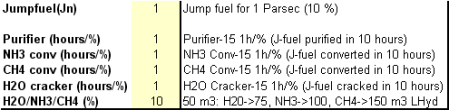
Water crackers ammonia converter and methane converters are rated in hours per hull percentage converted, this is the output percentage and not the input. A 1 hour per % water cracker would convert 0.67% of water into 1% of LHyd per hour, an equally rated ammonia converter would convert 0.5% ammonia into 1% LHyd per hour  and the methane converter would convert 0.33% of methane into 1% LHyd. The fuel purifier mentioned above, is also rated in hours per fuel percent purified.

Tanks and converters
Aside from reaction mass and jumpfuel you can add tankage for water/ammonia/methane, this tankage cannot be used directly, it needs to be converted into LHyd by an appropriate converter (NH3 converter, CH4 converter or H2O cracker).

Add a purifier if you want your LHyd clean and free of impurities. The purifier removes any Deuterium, Tritium, Helium or other traces from the LHyd, purifying your jumpfuel decreases the risk of misjumps and J-drive damage when using wilderness fuel. Some starports sell unpurified LHyd at a lower price.

Add fuelscoops to your ship if you want to skim gas giants for hydrogen, adding the aforementioned purifier will help you filter out the impurities from gasgiants. Note that not all gasgiants give you hydrogen when skimming, some will give you ammonia instead. The fuelscoops will convert your fission and fusion rockets into air breathers which will reduce fuel use and lessen radioactive waste when flying in an atmosphere.

Fuel skimming in Intercept
Skimming fuel from gasgiants is probably the most dangerous form of wilderness refuelling, how dangerous is up to each referee using whatever rules system he prefers. If you want to do fuel skimming during an Intercept battle you can use these rules:
Fuel skimming consists of repeatedly performing aerobrake manuevers on a gasgiant. As gasgiants are huge planets all skimming should be done with the large-scale rules (1 square equals 100 000 km, one turn equals one hour). How much fuel you get from each aerobrake pass depends on your speed prior to aerobraking; you get 20% fuel per brake G. Roll for aerobrake damage as outlined in the Intercept rulebook. If the ship is stationary in a gasgiant voluntary aerobrake square it can skim 5%.

Example The 60 000 dTom Azhanti High Lightning cruiser relies on its fuel shuttles for gasgiant skimming but in an emergency it can perform the skimming itself, at quite some risk. The hull of the Azhanti has a safe speed of 0.5 for aerobraking so each point of speeds adds +2 on its aerobraking damage rolls. Skimming at speed 1 down to 0 would give it 20% fuel per pass, three such passes and it will have replenished its jumpfuel. Each pass the Azhanti must roll at +2 for hull damage on the damage table ie a 4+ would cause Light hull damage. Yes, only in extreme emergencies will the Azhanti do the skimming on its own. You may wonder why they didn’t simply give the Azhanti Streamlined or better hull and the answer would be surface area. A warship needs lots of surface area to mount all their weapons and sensors. Tradeoffs I keep telling you, tradeoffs.

Relativistic rocks don’t kill people – People with relativistic rocks kill people.