Archive for the Rules Category

Missile combat

Posted in Intercept, Rules, Traveller, Vector movement with tags , , , , , on February 22, 2026 by Mr Backman

Do you see torpedo boats?
Kamchatka frigate of the Russian navy 1903

Missiles span everything from small 50 kg ones that are fired and either hit or miss in a single turn all the way up to 5 ton beasts that move and behave almost like a ship. Larger missiles than 5 ton should be built as unmanned ships and use the ramming rules when attacking, this is far outside of the scope of this post though. This post will only cover the small 50 kg mssiles that only last for a single turn called Snap missiles, the only ones normally allowed for Traveller characters). The rules for mssile combat is on page 12, penetration and damage on pages 14-15 and the optional Arc damage rules are on pages 38-39 in the Intercept rulebook.

Order of Actions

  • Missiles are handled in the missile combat phase, which comes after beam fire in the current ship’s combat turn.

Types of Missile Launches

  • Snap missiles fire immediately during the attacker’s ship combat phase.
  • Regular and cruise missiles launch earlierin the missile movement step of the movement phase.

Launch requirements

  • A Snap missile can only be fired if the target is within the launcher’s arc at the moment of firing. The launching crew must “see” the target in their firing arc.
  • Snap missiles can only be fired if the launch position is no more than missile thrust Gs away from the target.

Missile Movement

  • Once launched, Snap missiles are either shot down by the target, impact the target otr miss and run out of fuel. In all cases it is removed from play. In fact Snap missiles are never really present on the map. Regular missiles have their own movement but that is for a later blogpost.

Attack and defense resolution

  • Missiles use a separate attack sequence where you calculate hit chances based on launcher/gunner skills, attack vector, target size, and other modifiers such as remaining Gs of thrust, target drifting etc. Note degree of success.
  • If the target track the attacking ship it may use lasers to defend against the attack. Reduce the degree of the attack with the defense degree of success. Defensive lasers must have the missile attack position in its arc and the lasers cannot previously been used offensively. Lasers may be used defensively against every missile attack within its arc during a turn.
  • If the missile survive defensive fire it must check if it penetrates the armotr at the hitlocation. Penetration of a missile is strongly affected by the attack vector. If the missile penetrates it should roll damage based on degree of succes and missile damage, also heavily affected by the attack vector.
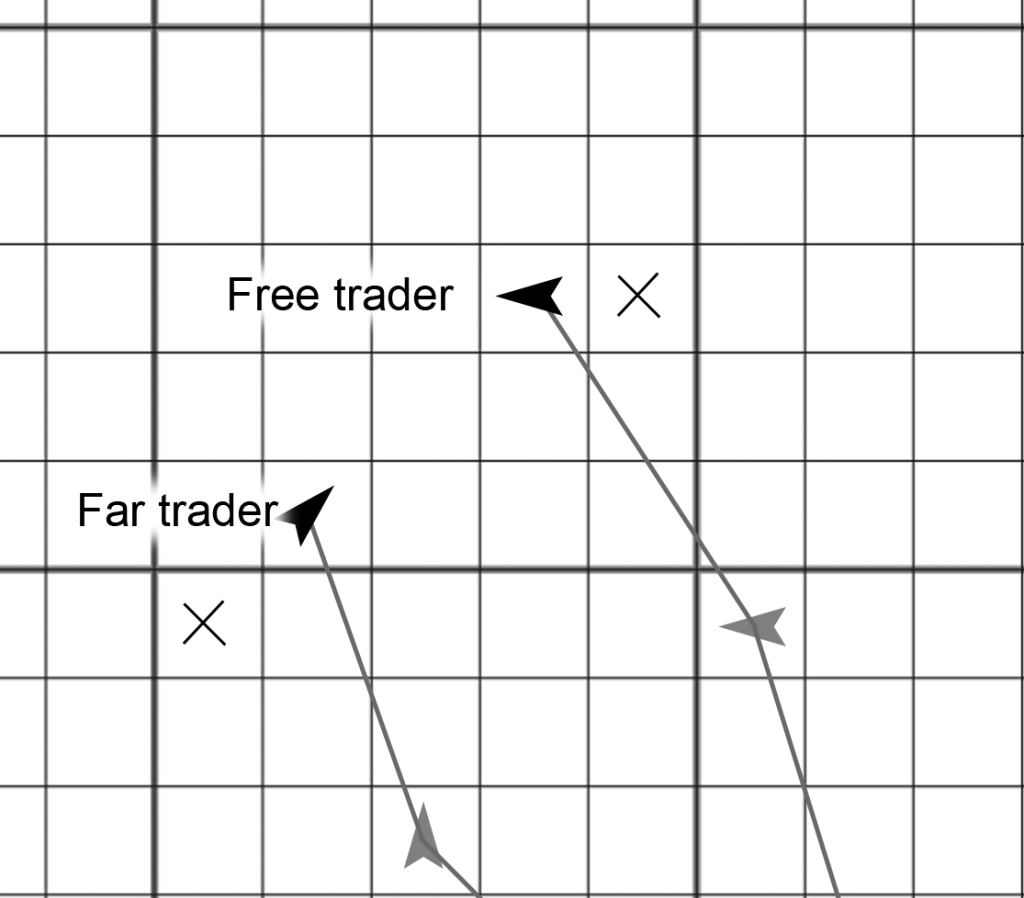
Launch position

Launched missiles use the Drift position from the launching ship instead of the actual position of the launching ship. We simply assume that the missiles were launched at the start of the turn and have been thrusting during the turn free from the launching ship.
Jamisons drift is 4 squares away from Grants ship, don’t forget that diagonals count as 1.5.
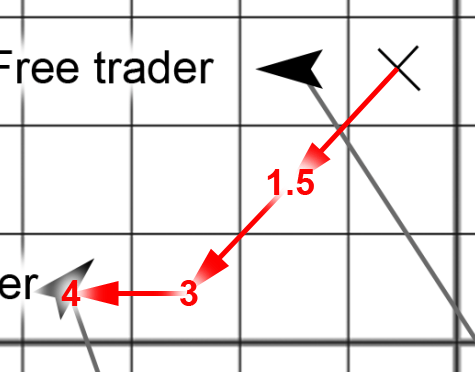
Attack vector

The missiles in Intercept use kinetic energy for damage, as would any space combat missiles in the real world. This means that what relative speed the missile impacts the target affect whether it will penetrate and how much damage it delivers, it also affects the likelihood of hitting as well as the likelihood of any point defense lasers stopping it. Our friend Newton would say this will require some vector algebra but thankfully I have come up with a really nifty way of avoiding all that, hang on.

The attack vector is simply the separation the attacker and target had last turn. Think about it, the two where separated that distance the last turn and now there are at the same position therefore the two of the somehow must have closed that distance in one turn and thus we have the speed, nifty! Just by coincidence the separation from the last turn was also 4 squares. It doesn’t matter in what order you do the straights and diagonals as long as you count the diagonal 1.5, and drop any final .5 from the distance measured.
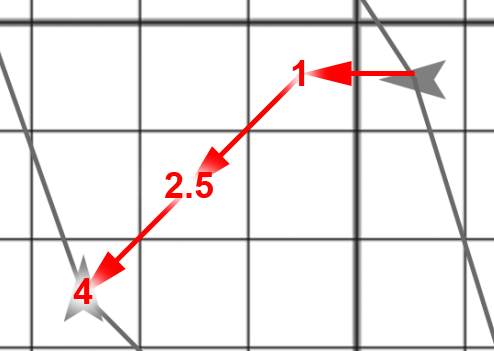

Targets in a thrusting attackers aft centerline cannot be attacked

A thursting ship has narrow arc to the rear where they are blind on all sensors and this means that the ship cannot use its lasers to defend against missile attacks originating from the aft centerline squares. Attack position here is the missile Launch position as mentioined above.

Missile attack
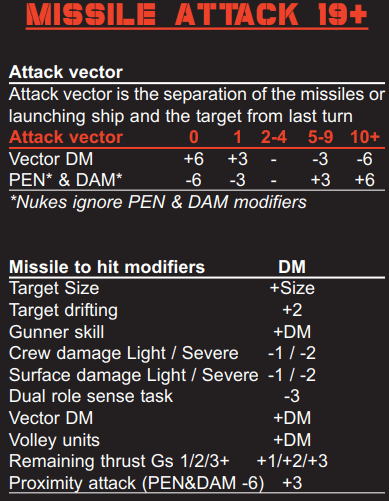
We have previously determined that the range (from Launch position to target) is 4 squares and that the attack vector also is 4 squares. The basic target number for missile attacks is a whopping 19+ but this is before we have applied the modifiers. Let’s go through each of the DMs:

This is the most important DM, a 100 dTon ship is +8 Size as Intercept use the same Size modifiers as regular combat, a human is Size 0.

If the target ship is drifting it is much easier to hit and thus the +2 DM. Drifting also makes any defensive fire easier.

This is simply the missile operators gunnery skill or missile skill if the rules have separate skills for that.

If the crew area has suffered damage the crew performance goes down of course, if crew damage is Critical they may not attack at all (nor defend or even pilot the ship).

Both ships weaponry and sensors are in the Surface location so their performance suffer when they take damage. If the optional Arcs damage rules are used (page 38-39 in the rulebook) each weapon or sensor has individual damage tracked.

Naval vessels typically have dedicated crew for sensors and gunnery but merchants typically have them serving dual roles. Dual role sensor/gunner crew suffer -3 on attacking/defending if they performed a sense task prior in the turn and they suffer a -3 on sense tasks if they attacked/defended in the previous turn. Don’t skip this rule in roleplaying situations, that high skilled lone trader should have a harder time than a properly crewed ship.

We previously determined the Attack vector to be 4 and this will determine the Vector DM as well as modifiers to PEN and DAM if we hit. A faster relative velocity makes the target harder to hit but also has more penetration and damage as Intercept missiles (the non nuclear ones) cause damage by kinetic energy. A speed of just 1 is equal to about 10 km per second and at that relative speed each kg of the impacting missile would inflect 10 times more damage than a kg of TNT! Attack vector of 2-4 gives a Vector DM of 0.

The number of missiles in the attack volley increase the likelihood of a hit, DMs from multiple missiles is on page 9 in the rulebook. As defensive lasers may defend against each and every volley their arc (we assune that each defensive fire takes only a small portion of the 15 minute game turn) so if multiple missiles are they to be launched it is better to group them into a volley than firing them individually. Each gunner can only fire one volley per turn so that may also limit the number of missile attacks.

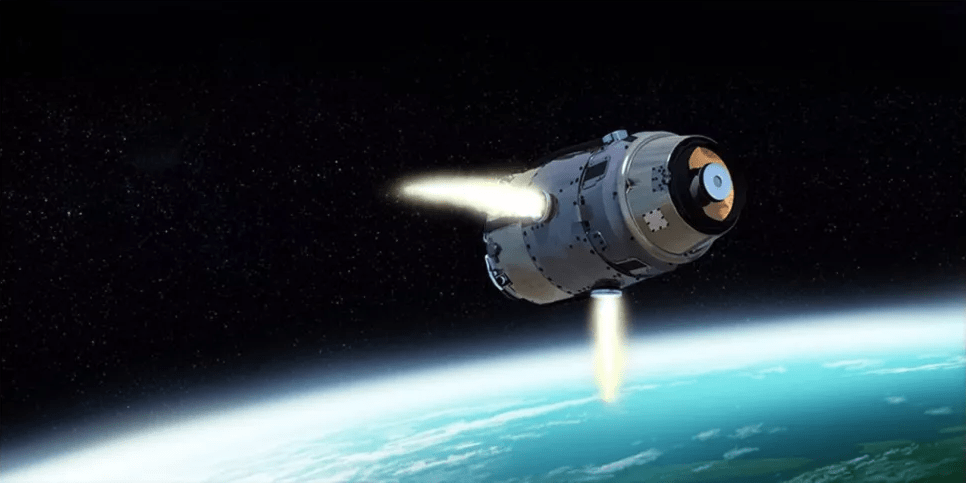
The missile may hit if its thrust Gs is enough to take it from its launch position to the target ship position, any remaining Gs will help its aim with +1 per G remaining up to a maximum of +3. If the Snap missile from the images above has 5G it would get a +1 for remaining thrust.

Hitlocation
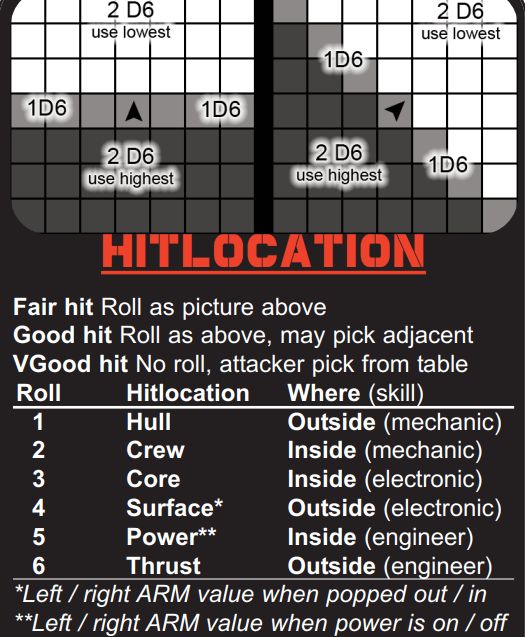
Hitlocation is based upon where the attack is coming from using the diagrams above. The Launch position is clearly in the front area sin the example o hitlocation rolls 2 D6 and picking the lowest D6. The actual hitlocation also depend on the degree of success after defense fire, Fair attacks use the hitlocation rolles, Good attacks may use the rolled one or pick any adjacent on the hitlocation table, rolling a 3 Core for example wouild let the attacker choose Crew, Core or Surface location. Very Good attacks let the attacker pick any hitlocation on the table.

Fair hits use the hitlocation rolled.

Good hits use the hitlocation rolled or the attacker may choose one adjacent to the roll.

VGood hits let you pick any hitlocation the attacker want.

Penetration
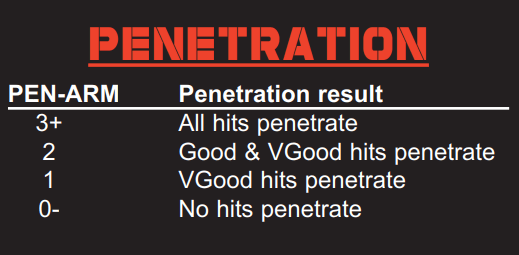
In order to score any damage the attack must penetrate the targets armor first and this is done by subtracting the mssiles PEN from the ARM of the hitlocation and looking it up. Missile PEN is heavily modified by the Attack vector, higher impact speed means better penetration and more damage. The Attack in the example is 4 which means PEN and DAM are unaffected.

Damage
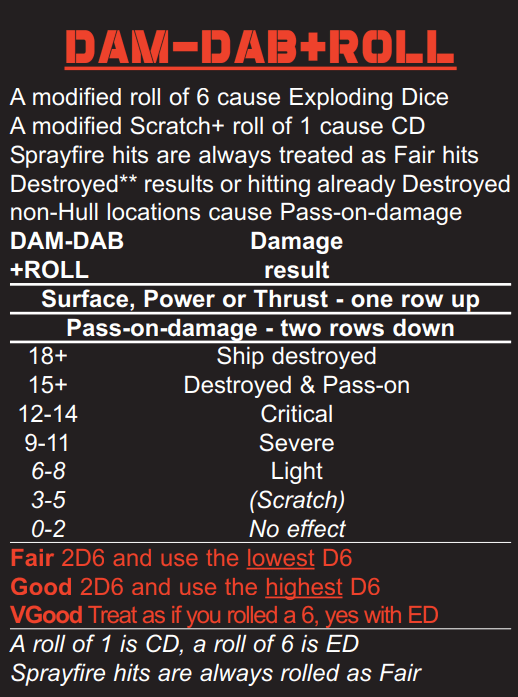
Damage is determined by subtracting the DAB of the ship from the DAM of the attack and adding a die roll that is rolled differently based on the hit task result. Look up the result on the damage table but after the degree of damage has been determined shift one row up if the hit location is Surface, Power or Thrust. If the damage is Destroyed & Pass on or you hit a location tyhat was already Destroyed or became Destroyed inflict tow rows damage on the Hull.

Fair hits roll 2D6 and use the lowest of the two, change of rolling a 6 is one in 36.

Good hits roll 2D6 and use the highest of the two, chance of rolling a 6 is 11 in 36, much better.

VGood hits don’t roll, you simply treat the result as if you rolled a 6, 36 in 36, as good as it gets.

If the result of the roll was a 6 you also roll Exploding Dice or ED for short. Roll 1D6 and add half the result rounded down, if that roll was a 6 you roll another ED dice and so on. If the result of the roll was a 1 you suffer Continuing Damage or CD for short, mark the CD checkbox on the ship paper.CD means that at the end of each turn, including this turn, by rolling 1D6 and increase damage if a 1-2 was rolled, the CD fizzles out on a roll of 6 so remove the CD check, rolling 1-5 and the CD remain. Whenever Repair Crew manages to Jury-Rig a damaged location the CD fizzles out too.

Summary

So there you go, an overly wordy description of missile combat. A brief summary would go something like this:

Lauch position Determine the missiles launch position (same as Drift position for Snap missiles). This will determine how hitlocation is determined.

Attack vector Determine the attack vector which is simply the separation between the ships from the last turn. This determines Vector DM when rolling to hit and Vector PEN & DAM modifiers if a hit was scored.

Attack roll Roll to hit and note the task result. Don’t forget the DMs from the attack vector.

Defense roll Defender if tracking the attacker may use lasers to defend, but obly if lasers haven’t already been used offensively in the turn. This defense roll reduce the degree of success of the attack, possibly down to a miss.

Hitlocation VGood hits pick hitlocation, Good roll but maybe pick adjacent and Fair attacks simply roll. How the roll is made depends on the where the launch position is versus the target.

Penetration Determine Penetration by comparing the PEN of the missikle and ARM of the hitlocation. PEN is heavily modified by the attack vector and ARM depend on hitlocation but also on wether weapons and sensors where popped out or the powerplant was running.

Damage roll Roll damage based on the degree of success. Note damage and possibly CD if a 1 was rolled.

So there, that is all there is to it, remember to watch your aft centerline and scan near yourself as missiles are deadly.

Motivations

Posted in Rules, Traveller with tags , , , on February 18, 2024 by Anders Backman

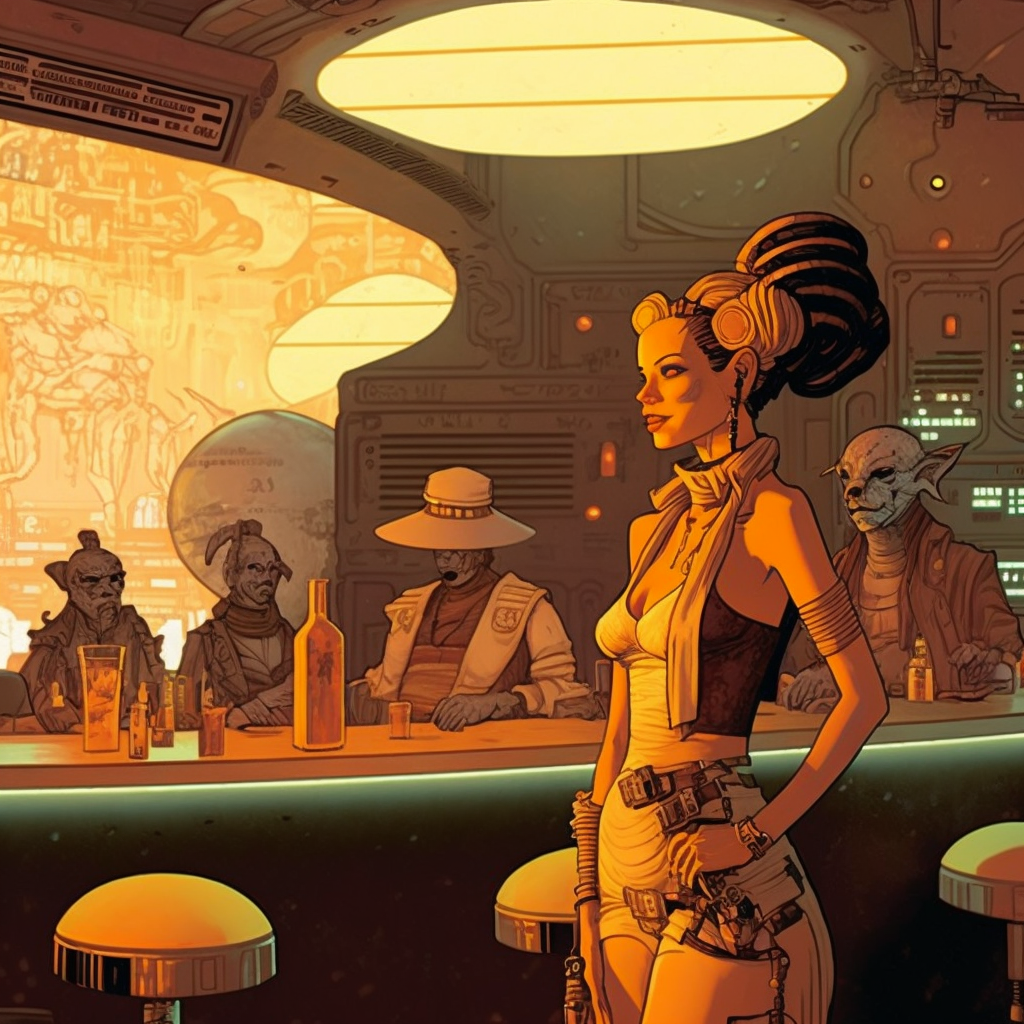
rowdy dark Mos Eisley starport bar, Moebius style, volumetric light, beautiful ladies --v 4

Men are so simple of mind, and so much dominated by their immediate needs, that a deceitful man will always find plenty who are ready to be deceived.
Niccolò Machiavelli

This system is here to help the referee in playing NPCs with different drives and personalities and to regulate how that will affect interacting. This system also help by forcing the referee away from cliches such as the 100% bribeable customs inspectors, the always fearless guards etc, try to accept the results as rolled except when the story need a particular personality.

There are eight different motivations Power, Duty, Wealth, Knowledge, Social, Antisocial, Action and Safety. Each motivation will have a description and then some notes for the referee on how to play them, giving of hints on their motivation can be great fun as the improvised theater aspect of role playing will then merge with the mechanics. “He’s always talking about what everything cost and how much he earns, maybe we should try to bribe him” meaning the players noted that the referee played him talking about prices and wealth indicating he has Wealth as motivation and is thus easier to bribe.

Power

The person is interested in power itself and control over others, the opposite of Duty. This power does not have to be political, it can be power over a company, family, crime syndicate, biker club, military etc. They find rational discussions hard and rarely change their view.

They use the words ”me” and ”I” a lot and makes sure everybody knows their name, they tend to interrupt others and want their plan or idea the one to be used.

Use Influence or Grovel as approach to to improve their reaction, avoid Reason as approach, one could say that Power motivated are always unreasonable.

Duty

The person has sworn to uphold his duty at all time, even if
the risk of getting caught is minimal. Duty can be towards the family, company, nation, army, faith or his sports team etc. They like to go by the book, follow rules and doctrines and dislike common sense or compromises.

They tend to have everything organized and neat, they speak of ”we” and ”us” of the organization and rarely have a sense of humor.

The only approach that work well with Duty is Pull rank but then you need to outrank in the organization they consider themselves dutybound to. Bribery is a particularly bad approach for those with Duty.

Wealth

Interested in getting rich and amassing expensive things, they are also likely to haggle for a better price whenever they can.They like if you are impressed by their things and how expensive they are, have a hard time understanding that things can have more value than money such as life, love, liberty.

Wealth persons always tell you how much they make and what everything costs, they always argue for a better price.

The best approach is Bribe of course but there are no bad approaches really.

Knowledge

Knowledge people are really into something, often science but it could be anything really; flying a ship, the limits of their body’s performance, model railroading etc. They are good at constructive criticism if you know their subject.

They always talk about  their interest and have a hard time grasping that others may not share their enthusiasm.

Approach them with Reason and avoid Grovel at all cost.

Social

Interested in relations, status, fame and worry about what others think of them. They like to gossip about celebrities, relatives and the like and talk a lot about their family and friends. They are generally easy to befriend, more so than any other motivation.

They ask how your partner, kids, family are and they know all their names. They also tend to gossip about celebrities and famous people.

Approach them with Influence or Grovel but there isn’t really any bad approaches.

Antisocial

Strongly relate to their own group and dislike or even hate
everyone else. Tend to think the opposite of the general consensus, often playing the devils advocate just for fun, obstinate. They also have a tendency towards fringe theories. They are generally hard to befriend, less friendly than any other motivation.

They badmouth others all the time and come up with conspiracy theories about everything. Hostile to new acquaintances, hard to befriend.

There are no particularly good approaches, avoid Grovel, you may only use Influence if the real SOC is equal.

Action

Likes physical hardship and danger. Are uninterested in careful planning, wants to go ahead and just do it. Have a hard time waiting, standing still or sitting for a long time. They love to compete at everything and often enjoy gambling.

They always have some wound or scrape they are healing from and like to talk about dangerous situations they have experienced, often in a humorous tone.

Bluff is a good approach as they tend to not think things through, avoid threatening them as their own safety is less important to them.

Safety

They fear strenuous activities, risk of damage or disease. Always wear safety belt, helmet, body armor, have a rescue-ball nearby etc. They have a hard time making a decisions, wants to got through every step again. Dislike competitions and gambling, are often religious in one way or another.

Always talk about how everything is getting worse. They often talk about various ailments they suffer, they are boring to be around.

Threaten is a good approach as they fear pain and danger more than others do. Avoid Bluff as these tend to think things through and carefully examine what you say.

________________________________________________________________________________________________________________

Generating motivations

Traveller motivations

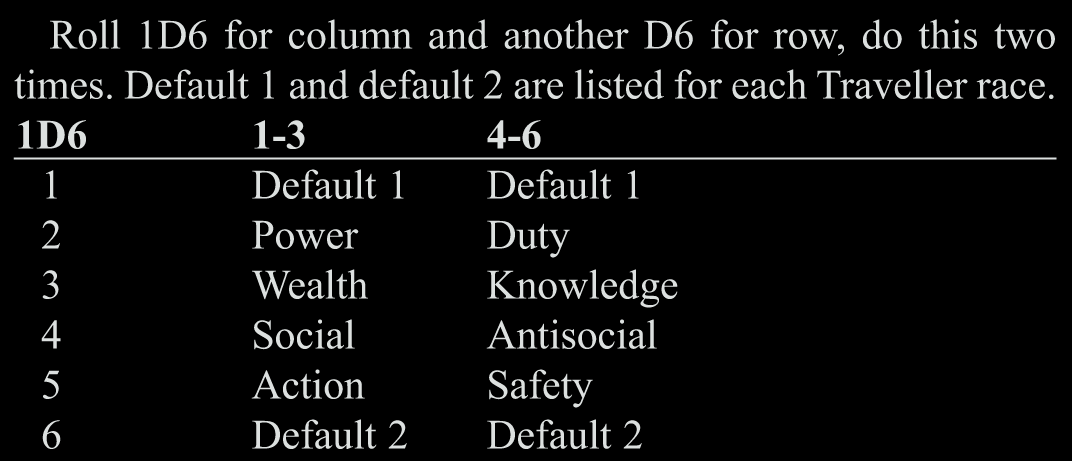
Each NPC will have two motivations, primary and secondary motivations. If both motivations are the same the NPC should be played as extreme in some way, possibly mad or having an addiction associated with the motivation. If the motivations are different they may conflict in certain situations, especially with pairs like Power and Duty ,Wealth and Knowledge, Social and Antisocial, Action and Safety, the primary motivation will mostly prevail but sometimes the secondary win through, play these as complicated neurotic characters.

Default motivations

Each Traveller race have two default motivations that are used when default 1 and default 2 show up on the random motivations table and also are the ones to use if the referee don’t have time to generate particulars.

  • Solomani or Vilani human Wealth Social
  • Zhodani human Duty Social
  • Vargr (can’t have Duty) Power Action
  • Aslan male (can’t have Wealth) Duty Action
  • Aslan female Wealth Duty
  • Kkree Duty Power
  • Hiver Knowledge Duty

Some examples of motivations

I’ll give you some examples of famous characters, real or fictitious, and my reasoning for why I gave them the motivations I did. You may not agree with me on my assessments but I still feel they may help you understand how motivations work.

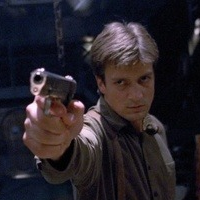
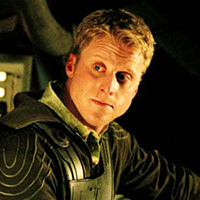
Malcolm Reynolds

Malcolm Reynolds – Action, Antisocial

Malcolm Reynolds is a man of action. He dislikes being too cautious and rarely things his actions through. He is also unfazed by threats, including deadly ones.

Mal wants to be the outcast, the rebellious, the devils advocate and always in opposition. In the Serenity movie his stubbornness almost make his crew fall apart. When the operative meet Mal at the companion retreat he neatly sums up his Antisocial motivation “I offer money you play the man of honor and take umbrage, I ask you to do what is right and you play the brigand…”

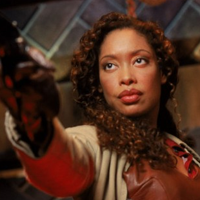
Inara Serra

Inara Serra – Duty, Social

Friendship and being liked by others is very important to Inara, especially the crew of Serenity and of course in particular captain Malcolm Reynolds whom she loves despite his rude ways and complete inability to express his feelings for her.

Inara is trained as a companion since the age of 12, and she takes great pride in being a member of this guild. Any insults towards the guild is treated as an insult to her and it is quite clear that she would choose the guild of companions over the Serenity if having to make a choice. In fact, in the film Inara has left Serenity as their shenanigans interfered too much with her work, and Malcolm never ever manning up to tell her what he feels probably didn’t help.

Zoe Washburn

Zoe Washburne – Social, Duty

Zoe likes the crew of the Serenity, she loves her husband too, she also have a very strong feeling of duty towards the brown coats of her war days in general and Malcolm Reynolds in particular, her superior during the war one of the few that survived it.

Hoban Washburn

Hoban “Wash” Washburne – Duty, Safety

Wash loves his wife and would do anything for her, Zoe is the boss here, simple as that. Aside from this Wash is the voice of reason in the crew, always arguing for a non violent or less dangerous way of solving things. Eventually he’ll agree to go along only because Zoe agreed to the plan.

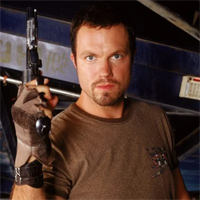
Jayne Cobb

Jayne Cobb – Action, Wealth

Well, Jayne love his guns, and knives, and grenades, don’t forget his grenades. He never thinks things through and tend to act in the moment. He also seems to like money a lot, probably to buy some more guns. Here is a revealing discussion between Mal and Jayne:

Mal “Why didn’t you turn on me?”
Jayne “Money wasn’t good enough.”
Mal “What happens when it is?”
Jayne “Well, that will be an interesting day.”.

Kaylee Frye

Kaylee Frye – Social, Knowledge

Kaylee loves flying machines and their engines, being a ships engineer is what she has dreamt about since she was small. But, she loves and cares for the crew of the Serenity even more and is also quite sensitive to what others think of her, especially the upper classes.

How to approach the Serenity crew then

Malcolm Reynolds – Action, Antisocial Being a man of action the best way of having Mal do your bidding is to bluff him. He rarely thinks a plan through and likes to go ahead right away. Avoid trying to impress him with your social status and don’t grovel either, he just hates these approaches being antisocial.

Inara Serra – Duty, Social Inara’s sworn duty is towards being a companion. If you are a higher ranking member of the sisterhood you can pull rank to make her do your bidding, if not your best bet would be use higher social class to influence her.

________________________________________________________________________________________________________________

Two examples of Power as motivation

As none of the Serenity crew had Power as motivations I thought I should give you two very different persons who both had Power as prime motivation, Steve Jobs and Adolf Hitler. Yes, these two people are very different in almost every way but showcasing these two as examples is to teach the referee that motivations contain no judgement, no good vs evil or anything like that, they are merely there to guide the referee in what makes them tick.

Steve Jobs

Steve Jobs – Power, Knowledge

Steve was a control freak if ever there was one. Every little detail had to be to his spec or you were out. He was however not interested in power for its own sake but to make his vision real, to make the next coolest thing, thinking beyond the box and not bothering with the bottom line. He famously refused a salary when coming back to Apple, he was forced to have one, $1 a year in order to be allowed a parking space supposedly, so he didn’t create iPhones to get rich (he did get fabulously rich though, as the board of directors poured rewards on him for getting shareholders rich).

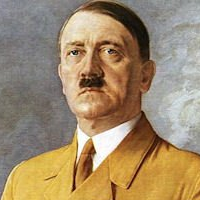
Adolf Hitler

Adolf Hitler – Power, Antisocial

Adolf Hitler was obsessed with power and control, to the detriment of the war effort some argue, as Hitler clearly wasn’t very good at warfare. Hitler was very charismatic and many in the third reich, and abroad, adored him, yet he didn’t have many actual true friends. His inner circle was constantly jockeying for the position of favorite, a situation that suited Hitler well.

________________________________________________________________________________________________________________

What to use and what to avoid

Improving reactions (Diplomacy, Grovel, Charm or Talk shop) and asking Favors (Pull rank, Influence, Persuade, Bribe, Bluff or Threaten) each have their pros and cons, as summarized in the chart below. The system for motivations, reactions, favors and lots of other interrelated stuff is available here.

Every living being is an engine geared to the wheelwork of the universe. Though seemingly affected only by its immediate surrounding, the sphere of external influence extends to infinite distance.
Nikolai Tesla

Synthetic Intelligence playing Intercept

Posted in Computer games, Intercept, Rules with tags , on October 6, 2021 by Mr Backman

Rumor has it that SI, a Synthetic Intelligence from the Ascent group will be playing Intercept. This has gotten the investors and backers of the game anxious to get get the latest and greatest version online ahead of schedule.

Fear not dear players, this is mostly minor tweaks and don’t worry; the Floater and large scale skimming updates promised in the last post are still on schedule, over and out.

Gas giant skimming

Posted in Intercept, Rules, Traveller, Vector movement with tags , , on September 29, 2021 by Mr Backman

Dangers of skimming they say, bah!

Sure, there are dangers, plenty of ’em too. Flying inside a gas giant’s vast gravity field isn’t dangerous per se, you can orbit them forever with no danger of being sucked in, the problem is that in order to skim hydrogen we must dip into the atmosphere and have it slow us down. Speed is what keep us from falling into the gas giant and we are intentionally slowing down while being as close to its crushing atmosphere as possible.

So, we dip in as deep as we dare and let the atmosphere slow us while our scoops gulp in as much gas as possible. Then we thrust away building up speed again to avoid the huge planets cold embrace. Some make one high speed approach and hard braking, others make a series of gentler dips instead, spreading out the danger. System Defense Boats and other daredevils sometimes even slow their ships down to zero deep within the atmosphere, hovering using their grav floaters and slowly scooping gas. No matter how you go about it the risks are real and minor damage to the hull is common.

As if the skimming itself wasn’t hard enough, there is also the real risk of pirate scum picking on us when we are the most vulnerable, they are rare but they do exist.

So there should be no surprise when I tell you that we do not skim that often. The time to enter and exit the huge gravity wells of gas giants offset the cost of getting fuel for free, time is money you see, especially as you must also pay for any hull damage inflicted by the skim.

So there you go, the dangers of skimming are real but not what you think!

Gas giant maps

Gas giants are, as is evident by their very moniker, huge. They are so large so they need special maps when used where the planet take up a large chunk of the map and their gravity field cover the rest of the map. Map sheets for small and large gas giants are available in the InterceptBundle here.

There is the possibility to use the Large scale rules on pages 34-35 and use the large planet maps for large gas giants and small planet maps for the small gas giants. This won’t be covered here though, just make sure you take the scale changes into account as outlined by the rules there.

Approach

Let us say we ha a streamlined ship with 1G of thrust, a Size of 8 (100 dTon) and a Pilot skill of 2, the computer is a model 1 giving us just 1D6 dice pool. The Pilot defaults table will give us 3(Miss) for 3 steps of turning every turn and the task result will be treated as a Miss. We will use the Pilot default on our approach flight but for the aerobrake turn we’ll dare an actual Pilot task roll trying to get a better result as the damage roll depends heavily on our Pilot task result.

The ship will fly towards the gas giant ass first, brake-thrusting to keep the speed from becoming too large from gravity – maximum safe speed/drag is 4/2 for airframes and 2/1 for streamlined. Keep those numbers in mind as you approach the gas giant. Try to hit the atmosphere edge on rather than head on when entering the voluntary aerobrake squares (the light grey area bordering the planet), also make sure that your ship face in the direction it will be going to head in the next turn.

The ship in the picture is thrusting to negate gravity (each x show where it would be if it drifted that turn). In the last turn it drifted and let gravity pull it into the voluntary aerobrake zone and speed it up to a speed of 4 (4.5rounded down). The circle around the ship show that it is drifting

The next turn we’ll go through aerobrake skimming step-by-step so please pay attention. This is a good moment to tell your crew over the intercom to buckle up, things can get bumpy.

Aerobrake skimming

Aerobrake steps

We’ll follow the steps from page 25 of the rulebook in some detail here, don’t worry though as it is much easier in practice. Print out a mapsheet and doodle away.

Decide drag and determine Pilot task result

Decide drag, then roll Pilot or use Pilot default to determine the level of success and the amount of turning available this crucial turn. Rolling the Pilot task will give you a better result on the average but with the Pilot default table you know what you get. We are moving at a speed of 4 and have decided to use 2 drag to stay in the 5-6 column of the Aerobrake DAM table, more on that later.

After deciding drag we will determine our Pilot task result. Pilot default has given us 3(Miss) for all of the turns of our approach but we will try to roll the Pilot task for the aerobrake hoping to get at least a Fair result, aerobrake damage depend heavily on the Pilot task result and a Miss is just not good enough we think. Rolling may give us worse than Miss of course but we bet that fortune smiles upon us. The ship is Size 8 and our Pilot skill is 2 with 1D6 dice pool so we roll 3D6 and pick the two highest and add 2.

Pilot task is rolled against the ships Size of 8 so we roll 1, 3 and 3 and use the two 3s for a die roll of 6 with 2 added, 8 – we just barely managed to roll a Fair result! This will give us 4 steps of turning but more importantly our damage roll will be based on a Fair result instead of a Miss, more on that later.

Drift and gravity (including Floater)

Gravity will take us back into the voluntary aerobrake zone again and our speed is still 4. Let’s zoon in a bit so we can see clearer.

Turn and thrust (or Initial Split-movement)

Typically you’ll only turn here, to face in your drift direction but nothing stops you from thrusting too, you may even do the first half of Split-movement here, go crazy but don’t forget that if you hit the planet you are dead. Our facing and vector are actually perfect so we’ll leave the ship as is here.

Pop-in and Forced facing

Now the ship pop in its surface fixtures which means that Visual, IR and Radar cannot Scan later in the turn, you do get to keep your Tracked targets and any launched missiles. We’ll pop in and hope that no coward pirate sneak up on us, for new targets we’ll be completely blind this turn.

Our ship is facing in the direction of our vector so there will be no Forced facing. Try to avoid this forced facing adjustment as it will increase the risk of damage quite a lot (your ships hull will be treated as one degree worse if adjusted here.

Aerobrake (first drag and then maneuver)

We decided on a drag of 2 two so let’s do them. We will simply move the drift two squares, one at a time. In our case there are no choices but sometimes there will be two options (zag-zig or zig-zag) and the Pilot can decide which one that is preferable as long as each step moves the drift closer (and thus reducing speed).

The ship has no wings and we didn’t adjust facing so there is no Maneuver to do. If we had some maneuver to use it would still be limited by the drag used (in this case 2), so maneuver could move the drift after aerobrake up to 2 in any direction. We have zero maneuver but if not we could maneuver to any square that wasn’t greyed out in the picture. Note that brake Gs are determined by counting the squares from our position before the aerobrake to the position after drag and maneuver.

Adjust facing

Our ship is still facing in the direction of our vector so no final facing adjustment is needed, this is mostly happening when a ship also uses Maneuver. This final adjustment of facing does not affect damage, it simply turns the ship to face the direction of travel.

Roll aerobrake damage

Aerobrake damage

We came in with a speed of 4 and our aerobrake took us 2 squares from that so our brake is 2. We’ll use the 5-6 column as 4 + 2 = 6. Our ship was Streamlined so our aerobrake DAM is 3. Now it’s time to roll the actual damage.

Aerobrake damage roll

Our Pilot task roll was Fair from the Decide drag and Pilot task step and the table tell us a Fair result will be rolled using 2D6 and picking the lowest and that the location of any damage is Hull.

We roll a 2 and a 5 and use the lowest one so 2 it is. Add 2 to the 3 we got from the aerobrake DAM table, 5 on the damage table is (Scratch), one point shy of Light damage. Some scorched paint and scratches is all we got from the aerobrake, let’s get out of here!

Skimming fuel

  • Skimming will net speed x brake x 5% of its hull per 15 min
  • Hovering will net 1.25% of its hull volume per 15 min

The ship did an aerobrake of  speed 4 and drag 2 which give us 4 x 2 x 5% = 40% of the ships hull volume skimmed. This is probably far more than the actual tankage we got so we leave the gas giant with full tanks and some scratches on the hull for our efforts.

Hover skimming

Hover skimming using Floater will be dealt with in a future post, stay tuned!

Large scale maps

Skimming can also be done using the 100 000 km per square, 1 hour per turn scale. In this scale large gas giants use the large planet maps and small gas giants use small planet maps. This will also be dealt with in a future post so stay tuned for that too!

So, to finish off my diatribe about the dangers of skimming by saying that the subs, the subsidized merchant crews are the bravest and here’s why:
A fully loaded sub has enough fuel for 4 hours of continuous 1G thrust! You normally use less than half of that to get to the jump point, which means that you have a bit more than half to maneuver towards the gas giant. What is even worse is that when fully loaded a sub’s Floater is only capable of negating about 60% of gravity, yeah, that is why they have those wings; to assist in takeoff when the Floater alone cannot do the job, and these guys sure need to turn every dime as their sponsors take half of what they earn.

I dare you to find a single subs skipper that has ever skimmed a gas giant fully loaded!