Archive for the Intercept Category

Traveller 40th anniversary

Posted in Intercept, Traveller on July 22, 2017 by Mr Backman

Traveller the roleplaying game is celebrating its 40th anniversary today so I took the opportunity to update rules, maps, ship design system etc to the latest version today.

Did you know that you can use Intercept with your Traveller characters with no conversion needed, at least if you use the classic system or anything similar to that? And that Intercept has premade versions of Freetrader, Fartrader, Subsidized merchant & launch, Scout courier, Survey cruiser, Patrol cruiser, Modular cutter, Mercenary cruiser, Close escort & launch, System defense boat & Jump shuttle, Fleet escort, Azhanti cruiser & Rampart fighter? Here! The rulebook, maps etc are available here.

Intercept is not Traveller but is compatible with it, at least at higher tech levels. High Guard and Striker weregreat sources of inspiration for the design system and what to focus on and what to change (GURPS Vehicles 2ed should also be mentioned here). I have been playing Traveller since 1978 with lots of different people, including my kids as they grew up. Many thanks to Marc Miller, Loren Wiseman, Frank Chadwick and of course the brothers J Andrew Keith and William H Keith Jr!

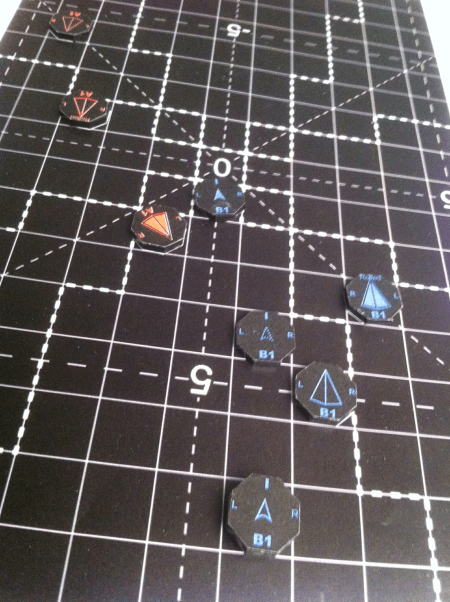
Travceller 40th anniversary

Traveller, Intercept and the banner of the Third Imperum on my balcony July 22 1017

Cinematic movement

Posted in Films and TV, Intercept, Vector movement on April 1, 2017 by Mr Backman

I have recently come to the conclusion that not many people find Vector movement to be neccessary or even preferrable for a space combat system. Less and less people read actual Science Fiction, ie something not based on films, games or comics, so it gets harder and harder to sell the idea that vector movement is how spaceships move and they should therefore like it.

So, today I have decided to go with the flow and embrace the more cinematic style of space combat. Battles from SciFi universes such as Star Wars and Star Trek could run battles using the Intercept rules with double blind hidden movement, fully deterministic, logarithmic values etc without foregoing their popular cinematic movement style.

What then IS a proper cinematic movement system? I have decided to break down the two most popular settings, Star wars and Star Trek and see how we could emulate that in our game:

Star Trek
I have complained about the various scientific inaccuracies of Star Trek but failed to mention its strengths; Star Trek shows us a positive and humanistic view of the future. Enterprise and its brave crew aren’t on a mission to subjugate planets and aliens, they are there to explore and help and always keeping in mind the prime directive, never interfere destructively. Star Trek also gave us the female perspective with Lt Uhura as a near equal on the bridge yet still able to express her female side with her short hemlines and sensuality. Star Trek also stress how important emotions are to us humans, always trumping cold logic. Kirk wins by persevering over staggering odds despite Spocks logic telling him his efforts are futile. We can learn something from this as politics is often too much ruled by logic and hard facts ignoring the very thing that makes us unique in the world; our emtions.

Star Trek ships use subspace warpdrives to quickly move from system to system. There are cases when they have battled during warp but this is too different to regular combat and will be covered in a future post. Star Trek ships always move with the nose in their forward direction. Some kind of drag seems to be in effect as ships with damaged impulse drives tend to slow down and ultimately stop. Top speed vary little between capital ships as is eveident from their inability to outrun each other. The Wrath of Kahn end battle has Kirk using thick clouds of a Nebula to turn the tides on Kahn instead of merely outrun him. The ability to turn seem more or less the same, regardless of speed and ship size.

Star Wars
I have often critizesed Star Wars for being a fantasy story disguised as Science Fiction. This may or may not be true as all Science Fiction is really nothing but some other literary genre in disguise (Blade runner is crime fiction, Barbarella and Zardoz is soft-porn etc). What Star Wars did to Science Fiction is to put religion as center stage. Many know me as a fervent atheist but what is atheism exactly, if nothing but a different faith? All humans need to believe in something and to hold something higher than himself, to serve and strive for. Star Wars also show us that not everything can be settled by a majority vote; there are issues and questions that must be handled by wise and spiritual elites, far better at judging changes in tradition and culture. Jedi knights show us a solution to the problems facing todays democracies; the lack of spirituality and disregard for tradition.

Star Wars ship jump between solar systems very much like the Traveller jump drives but no combat seems to occur while in jump space. Star Wars ship seems to have vastly different top speeds depending on size where smaller ships outrun bigger ones. Star Wars ships turn slower the faster they go as is evident if one analyze the dogfights in Star Wars Episove IV.

Star Trek cinematic movement rules
Use as much of the Deterministic optional rules as possible to get the feeling of Kirk and Klingon in a battle of the minds. It is especially important to use the deterministic ruls of Initiative where the Initiative goes to the ship which ‘skipped’ more steps, see the Deterministic combat rules for details on this.

Ships should note their speed and can move to any square in their forward arc. Turning is done anywhere during movement.

All ships can turn 4 steps each turn regardless of size, -1 step if Hull or Crew has Light damage, -3 if Hull or Crew has Severe damage. No turning if Hull or Crew has Critical damage.

Ships can increase or decrease speed by Acc, top speed is 6 regardless of Size, Acc etc. Ships lacking thrust reduce speed by 1 each turn until stopped.

Star Wars cinematic movement rules
Do not use the deterministic rules as Star Wars portray battles as individual skill rolls. Give your hero characters lots of skill bonus.

Ships should note their speed and can move to any square in their forward arc. Turning is done anywhere during movement.

Ships roll Pilot tasks vs Size as usual noting the steps of turning. Reduce turning steps by one for each full multiple of Acc in speed. Ships moving at top speed cannot turn at all.

Ships can increase or decrease speed by Acc, top speed is Acc * 4. Ships lacking thrust reduce speed by 1 each turn until stopped.

Well, that is all folks, get out and enjoy this beautiful April fools day!

Version 3.4.3 update

Posted in Boardgames, Design system, Intercept, Other vector movemet systems, Traveller on December 11, 2016 by Mr Backman

Board and counters

Vesta acquisition. In response to the verbal from the autopilot, Dieter Ulans flipped his datavisor in front of his eyes and prepared to take direct command of the massive ring of lasers and reaction engines that was Hercules. He hit the juicer button and felt the rush as the drugs began to wash into his veins. “Com’monn jockey juice!” he whispered and then began to croon: “All my thoughts of you, you, you — all that I’ve sought is you, you, you.” The tiny green symbols on the datavisor began to zip past his eyes at an increasing speed.

From the rulebook to Battlefleet Mars 1977 – Essentially the Expanse setting but 39 years before it aired.

Rules

There are lots of changes all over the rules, too many to mention. Sections have also been rewritten, gotten new or updated illustrations or have been rearranged, to clarify and simplify without actually changing too much.

As always, read the front page to get a feel how the game works. Then, read pages 2-3 which cover tasks and initiative, very important to grasp. From then on, simply start playing a turn and read as the turn progresses, the rules are written in turn sequence order.

You can download it all here, as usual, with the updated designs, maps etc.

Tasks

The task system has gotten a facelift and a slight change to what Miss margins give what result. All tasks are now highlighted in red in the table columns to make them easier to find, they are also duplicated on the four reference pages at the back. All degrees of success or failure are now three points wide:

  • Very Good You rolled at least 6 points above the target number.
  • Good You rolled 3-5 above the target number
  • Fair You rolled 0-2 above the target number
  • Miss You missed by 1-3
  • Bad You missed by 4-6
  • Very Bad You missed by 6 or more 

Movement

The movement rules are basically the same as before but rewritten and clarified with step by step illustrations on how movement is performed. The section on plotting has also been clarified and with a detailed example illustration showing all aspects of plotting.
fractional-thrust

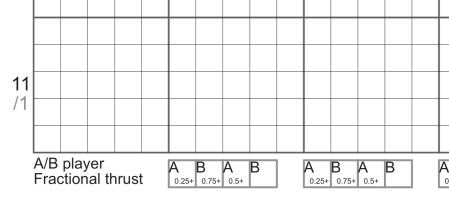
Fractional thrust Ships don’t come with Thrust in increments of whole Gs, fractions in increments of 0.25 Gs allow the ship an extra G on certain turns of every group of four turns. The mapsheet holds helpers for this and there is also check-boxes for fractional thrust, loaded and unloaded, on the ship Datacard too. All ready-made designs have these already filled in for you. A ship with 1.25 Gs of thrust would thrust 2 G on turn 1 and 1 G on turns 2-4, 2.5 Gs of thrust would thrust 3 G on turn 1 and 3 and 2 G on turns 2 and 4. A ship with 0.75 Gs of thrust would thrust 1 G on turns 1, 2 and 3 but cannot thrust on turn 4 of every group of 4 turns.
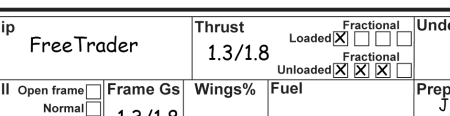
Free traderDatacard fractional thrusts

As damage to Thrust and Power affected how many Gs a ship could thrust this has been changed too, so you don’t have to recalculate what fractions to use as you get damage. Now Thrust and Power damage affects how many turns in a row you are allowed to thrust. All, 2 turns , 1 turn or not at all for No damage, Light, Severe or Critical damage. Plotting rules teach you to draw a circle around your ship whenever it drifts and thus reset the clock on thrust.

Sensors

The fundamentals of the sensor rules remain the same, just clarifications and better examples. The only changes I can think of is that you no longer can use your Visual/IR and Radar sensors when popped in. On the other hand, ships may now pop in at any time during a turn as long as they haven’t used their weapons yet. Ships lose any tracked enemies and any launched missiles when popping in but as you know the vector and position on your targets when they were tracked reacquiring them should be fairly easy.

Oh, one more thing. Intercept now allow 2×2 scans, 2×2 square scans are +2 (+4 for radar), 2×2 boxes are -2 (-4 for radar). I didn’t allow them before because they didn’t have a clear center but showing where your scan is located should pose no problem anyway.

Map coordinate legend

The plotting rules now teached how to refer to boxes and sqaures on the map, using the legends on the map. To efer to the top left box of the map, say “Ay-one”, to refer to the bottom left square of the box where the latrge planet is in say “Dee-six one-five”. Always use column-then-row for the boxes followed by column-then-row for the individual squares.

Combat

The combat section has been rewritten and lots of die modifiers have been removed or baked into other rules. How much a ship thrusts no longer affect how hard they are to hit, we simply give a +2 DM on attacks, and defense when  drifting.

Underpower When a ship didn’t have enough power to use all their weapons when thrusting or drifting we previously used two DMs, peculiarly placed low on the Datacard and was often forgotten (I admit to cobbling it in wherever there was room).

Freetrader underpower ratings

Now, Underpower is one of All+, All, 2 turns, 1 turn, No fire, ships have separate Underpower ratings for Thrusting, Drifting or Jump prepping (more on that in the optional hyperspace rules). When a ship has Severe damage in its power location its Underpower rating is one level worse, All+ becomes All, All becomes 2 turns and so on.

Damage

Damage has changed considerably in this version. Ships now have only one DAB (Damage ABsorption) rating for the entire ship instead of one per location, ARM (for ARMour) is still per location and sometime even have two values, popped out / popped in for Surface damage, full power / silent running for high powered power locations representing their vulnerable heat radiators.
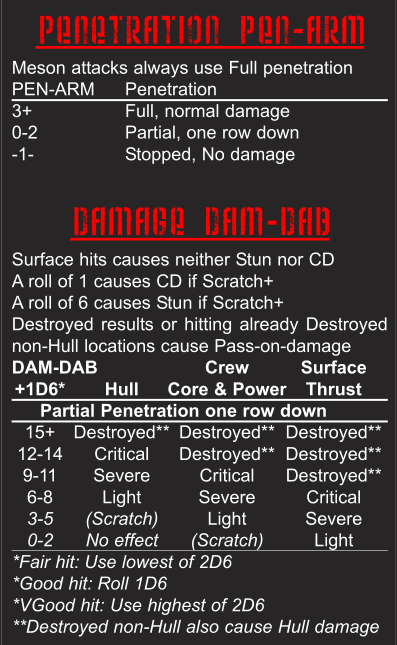
Penetration and Damage tables

How do we handle different damage at different locations then? We have three separate columns on the damage table, one for Hull, one for Crew, Core and Power and one column for Surface and Thrust.

Aerobraking & landing

I seem to rewrite the aerobraking and landing rules once every two weeks or so but now I have something that I feel I’m done with as it is fairly simple yet contains everything I want it to do. Docking and ramming has been moved to the optional rules as they tend to be used more rarely. I have increased the safe speeds for aerobraking somewhat so they become more useful. New illustrations and two examples help clarify things. there is even a little section dealing with your ships signatures when landed and how your sensors work through and atmosphere. Yeah, landing on the day side of a planet with atmosphere will make you harder to scan but your Visual/IR sensors will be blind from the bright atmosphere.

Optional rules

Campaign rules If you want to play a series of Intercept scenarios and have your crews and/or entire navy improving is skill from experience this is for you. The rules merely deal with how to track skill improvements but also skill loss from crew damage. There are also some bare bone outlines of scenarios to help you with ideas. This system is what we use at work when playing and interconnected series of space fights.

Redlining Have you ever wanted to pull all the safeties as captain Phillips did when Somali pirates tried to intercept him, or yell at your engineer ordering him to once again do the impossible? In other words, have you ever wanted to redline your engines?

You decide if you want a 50% boost to your thrust this turn or doubling it for a turn, the latter is of course more dangerous. There is a considerable likelihood that your thrust location will get a CD (Continuing Damage) ie ‘fire in the engine room!’ and you may even risk damaging your engine. Redlining, as well as powering up from silent running and the usual jury-rigging of battle damage is done by your trusty Repair Crew.
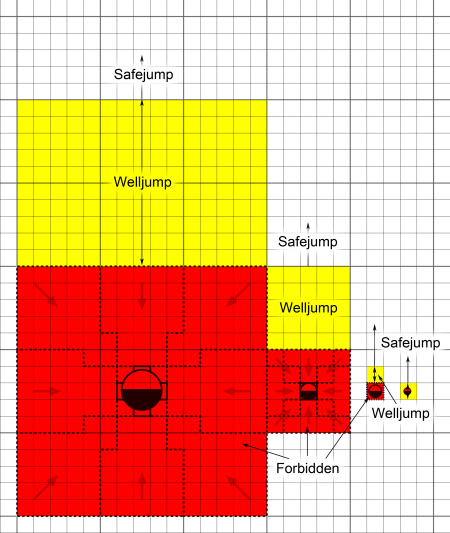
Jump distances for planets and asteroids

Hyperspace The rpg Traveller has a faster than light system that works by travelling far away from any planet, jumping into hyperspace, spending about a week there and exiting somewhere else parsecs away from where you started. I have shrunk how far one must travel to safely jump to fit planet and safe jump onto an Intercept mapsheet. There are some fairly detailed rules about how to jump, fuel use, astrogation, misjumps etc and where you will end up. In my system, all jumps have you end up somewhere, near a gas giant, planet or asteroid, even when you misjumped into an ’empty’ parsec hex in the original Traveller.

If you are playing a Traveller campaign I suggest you not only replace the space combat and starship movement rules with Intercept, replace the hyperspace rule too.

Design system

There are tons of changes to the design system too. Most importantly I think you get all the important design spec data in one place. As shown by this part from the Free trader design spreadsheet available in both InterceptBundle and Designs.
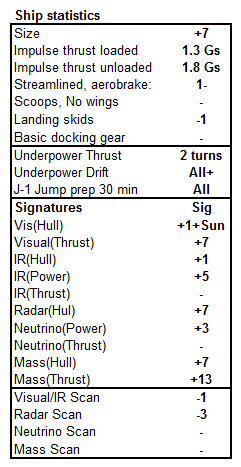
Ship stats for the Freetrader

Three little orange dots appeared on the screen. Look at him — blowing out decoys even though he knows we’re out of maneuver — that Kolnichok, grinned Dieter. So which one is you, Joey, and which are the aluminum balloons? (Seven dots grew on the screen, all had slightly different vectors.) Now you know my heater can take you in one flash and you also know that one zap is all I’m going to get. And if I take it you’ve got a perfect excuse to blow me up for the honor of the company rather than recapture valuable property for the accountants. So what’s it going to be? I think you shot off too many balloons too early Joey — cause the other ones aren’t making the course correction you just did. Ain’t that you, Joe?

Ulans squinted and tapped his foot.

From the rulebook to Battlefleet Mars 1977 – notice the green grid tactical maps where one could play out space battles with vector movement, in 3D no less, in 1977!
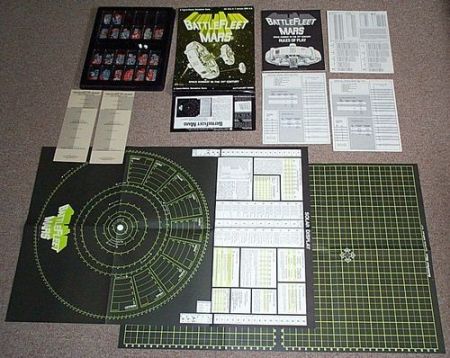
battlefleet-mars

The contents of SPIs Battlefleet Mars boardgame from 1977.

G-Loc update

Posted in Intercept on June 3, 2016 by Mr Backman

Falling off the hull

G-force induced loss of consciousness (abbreviated as G-LOC, pronounced ‘GEE-lock’) is a term generally used in aerospace physiology to describe a loss of consciousness occurring from excessive and sustained g-forces draining blood away from the brain causing cerebral hypoxia. The condition is most likely to affect pilots of high performance fighter and aerobatic aircraft or astronauts but is possible on some extreme amusement park rides. G-LOC incidents have caused fatal accidents in high performance aircraft capable of sustaining high g for extended periods. High-G training for pilots of high performance aircraft or spacecraft often includes ground training for G-LOC in special centrifuges, with some profiles exposing pilots to 9 gs for a sustained period.

Wikipedia

G-Load optional

The rules for G-load as well as mission and action Fatigue can be found on page 25 of the rulebook. G-Load is optional but quite fun, especially if you use Intercept to play out Traveller or other roleplaying situations. Don’t forget that aerobraking also cause Gs, simply count the number of squares from your gravity adjusted Drift and use that as GS below, regardless if the thrust come from actual thrusting or aerobrakes. Try making a space fighters with really high Gs by adding high strength Floorfield or a cheaper and less powrhungry alternativeis to use the Limited tank workstatios; submerged crew breathing oxegynated liquids can take 5 Gs without as much as flinch.

At the end of each ships’s movement phase calculate the G-Load and if 1+ roll for G-Loc and damage, calculate and roll separately for Crew and Repair
Crew. Sum up all Gs the ship is subjected to, basically the number of squares from the Drift after gravity position. Subtract 1 if the ship neither turned nor rolled, it is far easier to take a linear acceleration than the bucking-bronco variety.

G-Load is then reduced by crew stations and floorfield if applicable. We need to do separate calculations for Crew and Repair Crew as the Repair Crew don’t have stations and sometimes don’t even have a floorfield to protect them (when doing repairs on the outside of the ship, on the Hull or Surface locations).

Number of Gs thrusted or aerobraked

  • -1 if neither turning nor rolling
  • -2 for Limited, Full or Bridge station
  • -5 for Limited tank station
  • -Number of floorfield Gs if indoors*

*The Hull and Surface locations are considered outdoors and not helped by floorfield

G-Loc & damage roll
Roll for G-Loc and damage if G-Load is 1+
Roll separately for Crew and Repair Crew
Reduce Gs felt by 1 if ship neither turned nor rolled
If the modified G-Load is 1+ for Crew or Repair Crew roll 1D6 + G-Load on the table below. A result of a Scratch+ results in G-Loc, higher results also result in damage or even death, this is also true for robot only Repair Crew.
Crew cannot perform Scans, attacks, defense or control missiles. All launched
missiles are lost as are all Tracks.
Repair Crew cannot move from their current location, perform repairs or
power up powerplants. Note that Repair Crew on Hull or Surface suffer one level worse damage if the result was 7+, from falling off the hull under thrust. See the picture on top if you don’t understand why.