
The GURPS Spaceships design system is a really neat and elegant system and those using it may want to play out battles using my Intercept rules. I am no expert in using GURPS Spaceships so there will be errors in my treatment, please comment or e-mail me so they can be corrected.
Sensors and signatures
GURPS Spaceships (from here on called GS) doesn’t have all the sensor types of Intercept so we must make some assumptions about that. Intercept Visual/IR sensitivity is GS sensor level -6, scientific arrays also have a Neutrino detector at GS sensor level -9 and Tactical arrays have Mass detectors at GS sensor level -10, and yes, the multipurpose arrays includes both of them. Intercept Radar sensitivity is 2 x (GS sensor level -6).
- Visual / IR scan = GS sensor level -6.
- Radar scan = 2 x (GS sensor level -6).
- Neutrino scan = GS sensor level -9 if the ship has a scientific or multipurpose array.
- Mass scan = GS sensor level -10 if the ship has a tactical or multipurpose array.
Signature modifiers
Use these modifiers when directed to in the text for each signature
- Stealth sig = 2 x (TL – 6), ignore Chameleon systems.
- Neutrino stealth = 2 x (TL – 9) if Stealth, ignore Chameleon.
- Mass stealth = 2 x (TL – 10) if Stealth, ignore Chameleon.
- Acceleration sig (<1.0G) = -1
- Acceleration sig (1.0G+) = +0
- Acceleration sig (3.0G+) = +1
- Acceleration sig (10.0G+) = +2
- Powerplant sig (1-2 powerpoints) = -2
- Powerplant sig (3-9 powerpoints) = -1
- Powerplant sig (10-29 powerpoints) = +0
- Powerplant sig (30+ powerpoints) = +1
- Thrust type sig = Use the GS IR signature modifiers, basically +6 for fission thrust and +8 for fusion thrust (GS page 44-45)
Visual signature
This is the signature from reflected light, either from the central star or from starlight. The central star has a Sun factor of +6 when the ship is in the hospitable zone, +1 for each orbit inwards and -1 for each orbit outwards of the hospitable zone down to a Sun factor of +0. Use the Visual(HullShadow) when the ship is in shadow of a planet.
- Visual(Hull) = Ship SM – 6 + Sun factor (typically + 6) – Stealth sig
- Visual(HullShadow) = Ship SM – 6 – Stealth sig
- Visual(Thrust) = Ship SM + Thrust type sig + Acceleration sig (unaffected by Stealth)
IR signature
The IR signature comes from basic thermal radiation from the hull, the heat from any active powerplants and from reaction engines. The IR(Hull) signature is affected by proximity to the central star as +1 per orbit inside the habitable zone if the ship is not in planetary shadow.
- IR(Hull) = Ship SM – 6 – Stealth sig +1 per orbit inside habitable zone if not in planetary shadow.
- IR(Power) = Ship SM + Powerplant sig – Stealth sig
- IR(Thrust) = Ship SM + Thrust type sig + Acceleration sig (unaffected by Stealth)
Radar signature
The radar signature comes from microwaves or ladar pulses bounced off the hull and back to the sensor. This two-way trip is why the scan size modifiers are doubled for radar.
- Radar(Hull) = Ship SM – Stealth sig +2 if not streamlined
Neutrino signature
The neutrino signature comes from fission or fusion reactors in the ship or from fission or fusion rockets. GS doesn’t have neutrino stealth so we assume they come with TL 10+ Stealth tech.
- Neutrino(Power) = Ship SM + Powerplant sig (ignore cosmic powerplants) – Neutrino stealth
- Neutrino(Thrust) = Ship SM + Thrust type sig + Acceleration sig (unaffected by Stealth) (ignore if chemical, HEDM or electric) (unaffected by Stealth)
Mass signature
The mass signature comes from the ships mass, any operating contragrav lifters, artificial gravity and gravitic compensators. GS doesn’t have mass stealth so we assume they come with TL 11+ Stealth tech.
- Mass(HullNoFloorfield) = Ship SM – 6 (if no artificial gravity nor gravitic compensators) – Mass stealth
- Mass(HullFloorfield) = Ship SM (if artificial gravity or gravitic compensators) – Mass stealth
- Mass(ThrustContragrav) = Ship SM + 6 (unaffected by Stealth)
- Mass(ThrustReactionless) = Ship SM + 6 + Acceleration sig (unaffected by Stealth)
Movement and performance
Intercept is designed for the ships with 1-6 Gs of acceleration and enough remass to keep accelerating for a couple of hours, solar sail and Ion thruster ship will be sitting ducks in this system.
Combat and damage
One can use the hitlocation and damage rules for GURPS Spaceships as they are and only use the Intercept sensor rules. Fine, go ahead, but those who like the easier to use Intercept version should read on.
GURPS uses dDam based on square root of energy, dHP based on the square root of mass and dDP based on linear thickness. Intercept uses logarithmic DAM, DAB and ARM so this part needs some heavy converting. I will use the Intercept damage system as it is so much simpler to use so the GS values has to be converted into Intercept values. We know that when at least 10% but less than 50% hull HP is suffered in an attack the hull section is Disabled, if 50% or more is suffered the hull section is destroyed. When the ship as a whole has suffered 200% of original damage it must roll HT to avoid breaking up and if reduced to 600% HP it automatically is destroyed. How do we convert that into Intercept terms?
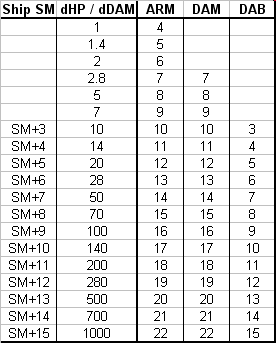
Let’s say that Critical damage (ie disabled) is at 30% of dHP then all the other damage levels follows as Light damage = 3%, Severe damage = 10% damage, 30% damage = Critical damage and 100% damage = Destroyed. Destroying the entire hull requires 300% damage and we ignore HT altogether. So where will our baseline be, what level of dHP equals DAB 0? To make a long story short I have already had the table in the oven for the customary 90 minutes, I’ll just put on my oven mittens so we can take a look at that freshly baked table.
Use the table below for converting just about everything into Intercept ARM, DAM and DAB. Look up your values in the dHP/dDAM column using the table value that is equal or lower than your GURPS value. Each D6 averages 3.5 which means that 14, 28, 140 etc will be short shifted in rounding so you might consider rounding 14 -> 15, 28 -> 30 etc. Oh, wait. I have a better idea: I fix the table for you!
Weapons
GURPS Spaceships weapons are a bit tricky as they cover such a huge span, even down to the slightly ridiculous shell firing guns. Intercept assumes lasers that fire tens of thousands of kilometers even for small weaponry while GURPS Spaceships have much smaller ranges (GURPS Spaceships is probably more realistic that way but I needed weapons to fire effectively out to ranges where dodging from lightlag would come into play).
We assume all 1/2D ranges from GURPS in miles to be ten times that in Intercept, in kilometers, 1000 miles becomes 10 000 km, the 1/2D range is the effective range in Intercept. Calculate the average points of dDam from the weapon (each D6 gives 3.5 points) and look up the corresponding DAM on the table above. GURPS use armor divisors instead of a separate PEN value so we start with a PEN value equal to DAM and then modify according by the armor divisor:
- Armor divisor 1.5: PEN+1
- Armor divisor 2: PEN+2
- Armor divisor 3: PEN+3
- Armor divisor 5: PEN+4
- Armor divisor 7: PEN+5
- Armor divisor 10: PEN+6
Hitlocation
Intercept uses a simple hitlocation system with six locations while GS has three sections with six locations each, plus two core systems added as an obvious fudge to keep each system 5% of hull mass. We will keep the GS hitlocations and add our own rules on how to hit them. In reality we will need two hitlocation systems for GS, one for regular combat and one for the optional deterministic system.
The regular system simply have you roll 1D6 and adjusting what six hull sections can be hit based on the direction of the attack. This is basically the same as in GS with the addition of Front left/right direction with hits half in the Front section and half in the Central section, and the Rear left/right direction where half the hits goes into the Central section and the other half into the rear section. This system makes the top three Front hull systems and the bottom three Rear hull systems less likely to hit.
The Deterministic (diceless) system uses the same tables below but with the following changes:
- Fair hit The target picks the section among the six eligible from that attack direction.
- Good hit The attacker picks the section among the six eligible from that attack direction.
- VGood hit The attacker picks the section among all 20 hitlocations. Yes, he can even choose one of the two [core] sections.
Front
- 1 Front hull 1
- 2 Front hull 2
- 3 Front hull 3
- 4 Front hull 4
- 5 Front hull 5
- 6 Front hull 6
Front Left/Right
- 1 Front hull 4
- 2 Front hull 5
- 3 Front hull 6
- 4 Central hull 1
- 5 Central hull 2
- 6 Central hull 3
Side left/right
- 1 Central hull 1
- 2 Central hull 2
- 3 Central hull 3
- 4 Central hull 4
- 5 Central hull 5
- 6 Central hull 6
Rear left/right
- 1 Central hull 4
- 2 Central hull 5
- 3 Central hull 6
- 4 Rear hull 1
- 5 Rear hull 2
- 6 Rear hull 3
Rear
- 1 Rear hull 1
- 2 Rear hull 2
- 3 Rear hull 3
- 4 Rear hull 4
- 5 Rear hull 5
- 6 Rear hull 6
Miscellanea
Example Star-Flower class Tramp Freighter from GS [TL 11^] The Star flower is a SM +8 design so the ships signatures will be the following:
Visual(Hull) = +8 (SM – 6 + Sun)
Visual(HullShadow) = +2 (SM – 6)
Visual(Thrust) = – (the standard reactionless engines give off no visual signature, except maybe the cheesy blue glow CGI artist add to every ships they lay their hands on)
IR(Hull) = +2 (SM -6)
IR(Power) = +6 (SM -2 for the two power points from the fusion reactor)
IR(Thrust) = – (the standard reactionless engines give off no IR)
Radar(Hull) = +8 (the ship is streamlined so it gets no extra +2)
Neutrino(Power) = +6 (SM -2 for the two power points from the fusion reactor)
Neutrino(Thrust) = – (the standard reactionless engines give off no neutrino signature)
Mass(HullNoFloorfield) = +2 (this is if the ship has its artificial gravity off )
Mass(HullFloorfield) = +8 (this is when the ship has its artificial gravity on)
Mass(Thrust) = +14 (the 2G reactionless drives gives off a strong mass signature)
The ship sensors are as follows:
Visual sensitivity = +4 (GS sensor level 10 – 6)
IR sensitivity = +4 (GS sensor level 10 – 6)
Neutrino sensitivity = – (the ship lacks scientific array)
Mass sensitivity = – (the ship lacks a tactical array)
Next comes the ships sections ARM and DAB and its weapons DAM and Effective range:
Ship ARM = 9 (dDR of 7 gives us ARM of 9)
Ship DAB = 8 (dHP of 70 gives us a DAB of 8 for the entire ship)
DAM = 11 (we convert the 10 MJ laser turret’s 4D6 to 14 dDam)
PEN = 13 (PEN is the same as DAM modified by the armor divisor of 2 which gives us PEN+2)
Effective range = 1 square (we use the tables in GURPS Spaceships 3 using the 1000 mile column as our 10 000 km).
There is no maximum range in Intercept, the PEN and DAM just go down by -3 for every rangeband beyond effective.
Using Imperial units for Science Fiction is like using Roman numerals for physics. The metric system has been with us since the French revolution, when will you colonials catch on?
 Vector movement