Archive for the Intercept Category

Goodbye Vectors, hello April fools!

Posted in Boardgames, Films and TV, Intercept, Rules, Science fiction, Vector movement on April 1, 2013 by Mr Backman

I have recently come to the conclusion that not many people find Vector movement to be neccessary or even preferrable for a space combat system. Less and less people read actual Science Fiction, ie something not based on films, games or comics, so it gets harder and harder to sell the idea that vector movement is how spaceships move and they should therefore like it.

So, today I have decided to go with the flow and embrace the more cinematic style of space combat. Battles from SciFi universes such as Star Wars and Star Trek could run battles using the Intercept rules with double blind hidden movement, fully deterministic, logarithmic values etc without foregoing their popular cinematic movement style.

What then IS a proper cinematic movement system? I have decided to break down the two most popular settings, Star wars and Star Trek and see how we could emulate that in our game:

Star Trek

I have complained about the various scientific inaccuracies of Star Trek but failed to mention its strengths; Star Trek shows us a positive and humanistic view of the future. Enterprise and its brave crew aren’t on a mission to subjugate planets and aliens, they are there to explore and help and always keeping in mind the prime directive, never interfere destructively. Star Trek also gave us the female perspective with Lt Uhura as a near equal on the bridge yet still able to express her female side with her short hemlines and sensuality. Star Trek also stress how important emotions are to us humans, always trumping cold logic. Kirk wins by persevering over staggering odds despite Spocks logic telling him his efforts are futile. We can learn something from this as politics is often too much ruled by logic and hard facts ignoring the very thing that makes us unique in the world; our emtions.

Star Trek ships use subspace warpdrives to quickly move from system to system. There are cases when they have battled during warp but this is too different to regular combat and will be covered in a future post. Star Trek ships always move with the nose in their forward direction. Some kind of drag seems to be in effect as ships with damaged impulse drives tend to slow down and ultimately stop. Top speed vary little between capital ships as is eveident from their inability to outrun each other. The Wrath of Kahn end battle has Kirk using thick clouds of a Nebula to turn the tides on Kahn instead of merely outrun him. The ability to turn seem more or less the same, regardless of speed and ship size.

Star Wars

I have often critizesed Star Wars for being a fantasy story disguised as Science Fiction. This may or may not be true as all Science Fiction is really nothing but some other literary genre in disguise (Blade runner is crime fiction, Barbarella and Zardoz is soft-porn etc). What Star Wars did to Science Fiction is to put religion as center stage. Many know me as a fervent atheist but what is atheism exactly, if nothing but a different faith? All humans need to believe in something and to hold something higher than himself, to serve and strive for. Star Wars also show us that not everything can be settled by a majority vote; there are issues and questions that must be handled by wise and spiritual elites, far better at judging changes in tradition and culture. Jedi knights show us a solution to the problems facing todays democracies; the lack of spirituality and disregard for tradition.

Star Wars ship jump between solar systems very much like the Traveller jump drives but no combat seems to occur while in jump space. Star Wars ship seems to have vastly different top speeds depending on size where smaller ships outrun bigger ones. Star Wars ships turn slower the faster they go as is evident if one analyze the dogfights in Star Wars Episove IV.

Star Trek cinematic movement rules

Use as much of the Deterministic optional rules as possible to get the feeling of Kirk and Klingon in a battle of the minds. It is especially important to use the deterministic ruls of Initiative where the Initiative goes to the ship which ‘skipped’ more steps, see the Deterministic combat rules for details on this.

Ships should note their speed and can move to any square in their forward arc. Turning is done anywhere during movement.

All ships can turn 4 steps each turn regardless of size, -1 step if Hull or Crew has Light damage, -3 if Hull or Crew has Severe damage. No turning if Hull or Crew has Critical damage.

Ships can increase or decrease speed by Acc, top speed is 6 regardless of Size, Acc etc. Ships lacking thrust reduce speed by 1 each turn until stopped.

Star Wars cinematic movement rules

Do not use the deterministic rules as Star Wars portray battles as individual skill rolls. Give your hero characters lots of skill bonus.

Ships should note their speed and can move to any square in their forward arc. Turning is done anywhere during movement.

Ships roll Pilot tasks vs Size as usual noting the steps of turning. Reduce turning steps by one for each full multiple of Acc in speed. Ships moving at top speed cannot turn at all.

Ships can increase or decrease speed by Acc, top speed is Acc * 4. Ships lacking thrust reduce speed by 1 each turn until stopped.

Well, that is all folks, get out and enjoy this beautiful April fools day!
Life as a starship technician

Posted in Intercept, Rules on March 1, 2013 by Mr Backman

We the technicians are the unsung heroes of the spacelanes I tell you. Them flyboys get all the credit but if it wasn’t for us tech-monkeys the ships would be dead in orbit and all the flyboys could do would be to wank their joysticks.

We are always ordered to the places most likely to get hit and when we work on the outside, fixing breached hullplating or misaligned laser mirrors, we are only protected by our worn, greasy, smelly vaccsuits. The commander and his flyboys rarely consider us when they kick off those fancy maneuvers so we are used to get banged about in our safety harness or worse – every tech-monkey has a friend that fell off a thrusting ship and was left behind to suffocate in his suit. The old fusion-torches at least gave you a merciful instant death as you fell into the drive plume, todays Impulse drives are as cold and indifferent as the commander and his cronies.

So when you see us monkeys in a bar winding down between missions give us a toast or better yet, buy us a beer, in honor of our thankless job.

Technicians
A ship needs one technician for every 50 MCr in price or fraction thereof, more expensive parts need more love from the techs, maintenance, calibration, vacuum-arcing protection etc. Technicians does not need stations as the rest of the crew does, it is assumed that any readout panels, interfaces etc are located on the devices themselves.

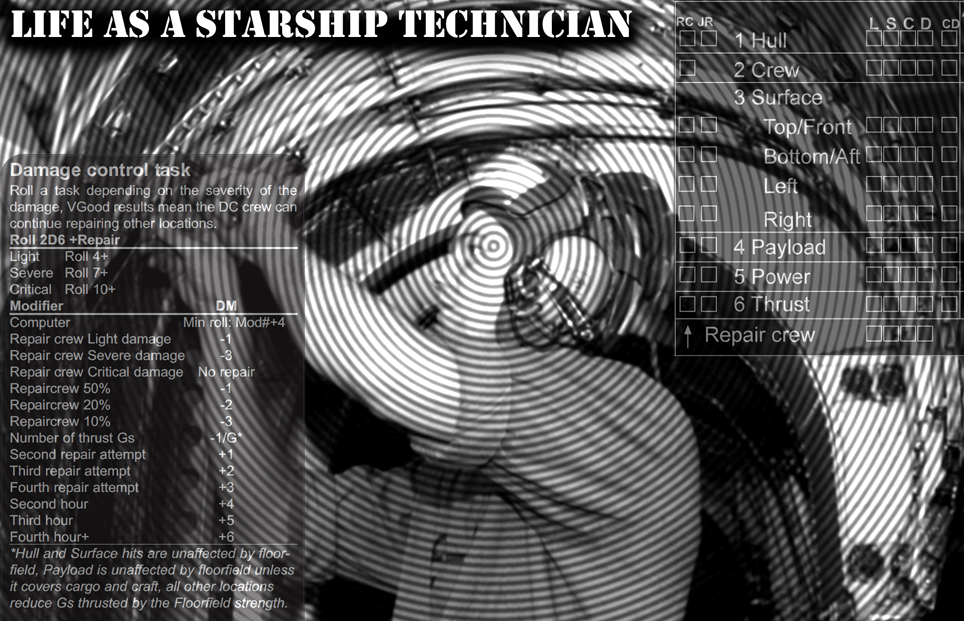
Technicians roam the ship as they do their maintenance chores and this is reflected in the rules by having a check box for what location the repair crew (RC) is in at the moment, failure to check a box is treated as having the RC in the Payload section.

Two of the ship sections are considered outside, Hull and Surface, while the rest are inside the ship. Being outside is dangerous as any attacks that hit that location will do damage to the RC ignoring armor, there is also the risk of falling off a maneuvering ship. The Crew section cannot be repaired by the RC but they can still be located there for whatever reason (Crew being the safest indoor location for attacks from the rear for example). The Repair Crew itself cannot be repaired, it cannot even be topped off from Frozen Watch revival. Damaged RC is for keep so treat them carefully.

Robots
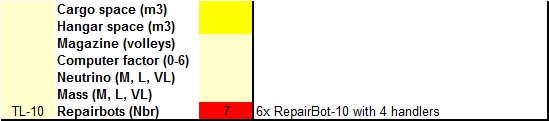
The number of required technicians for a large spaceship can be staggering, one or every 50 MCr, and one way to reduce that number is to employ robots that assist the technicians. How many robots can be handled per handler rises with Tech level, from one robot per handler at TL 8 to a 100% robot repair crew at TL 14 or higher. Robot stables etc are included when adding robots to your design. If you enter more robots than needed the cell will turn red.

Too many robots

Repairs
Technicians repairing battle damage can only jury-rig the damaged components. There is neither time nor spare parts for proper repairs, this has to be done at a starport or Naval base later. Repair crew is moved between locations at the start of the Repairs phase and roll a task to repair that location.

  • 4+ for Light damage
  • 7+ for Severe damage
  • 10+ for Critical damage
  • Destroyed locations cannot be repaired.

There are lots of more modifiers to the Jury-rig roll in the rulebook. Note especially the -1/Gs DM for Thrusting. This modifier applies to all repair attempts but reduce that figure by the number of Floorfield Gs in the Crew section and in the Payload section if the Floorfield covers the cargo hold as well.

A succesful Jury-Rig does not reduce the damage marked on the Ship form, instead tick off the JR check box (for Jury-Rig) to indicate that the damage should be treated as one level less than it actually read, Jury-Rigs also remove any Continuing Damage. Jury-Rigs revert whenever that location is hit for any damage, even if the hit didn’t actually increase the damage level, that is why the (Scratch) damage level is on the damage table.

There is an optional rule that limit Repair Crew mobility when they are Severely damaged to two locations up or down per turn. Whenever a location is hit that the Repair Crew is in roll damage separately for the location and the crew, for hits on Hull or Surface also ignore any detrimental PEN vs ARMOR effects when rolling the Repair Crew damage. Hits that are completely stopped by armor  will still do full DAM – DAB to the Repair Crew. Yeah, that is half of why the Repair Crew hate the commander for ordering them outside, see Falling off below for the other half.

Repair crew can never be ‘repaired’ during battles, neither by technicians nor by activation of the Frozen watch, if they are gone they are gone, get replacements at the next starport, the same goes for their robots.

Damage
If an indoor section suffers damage when the repair crew is located there the repair crew suffer the same damage. Track damage to repair crew separately, including cumulative effects. If the repair crew is in the Power section that already has suffered Light damage and a new hit gives another Light damage the Power section becomes Severe damage (from cumulative damage, new damage of the same degree raises the damage one level) while the RC is now Light damaged.

Falling off
Repair Crew working on the outside of the ship (Hull or Surface locationa) may fall off when the ship is maneuvering. Consult the optional G-Loc rules for details. Falling off a ship with an active Fission or Fusion thruster will kill the fallen instantly, you have been warned.

Familiar space technician

Tsiolkovsky’s rocket equation

Posted in Intercept, Science with tags , , on December 28, 2012 by Mr Backman

I was fiddling with a TL-8 fission rocket design for going to the moon and back as cheap as possibly when I noticed something strange; going for more advanced materials would lower the mass of the ship and thus increasing its acceleration but it had no effect on delta-V? The design was for an upcoming article on landings, takeoffs, aerobraking, docking and ramming. It turned out to be just a bug and together with this post you can download the updated design spreadsheets, designs etc at the usual location.

Then I realised that the rules doesn’t dwell much on low tech rocket design, delta-V, mass ratios and such. These are the bread and butter of ‘real’ rocket design, and at the core of this rocket science art is the Tsiolkovsky’s rocket equation. Cool name for a post covering up my spreadsheet blunder and here we are.

Tsiolkovsky, Russian rocket pioneer and visionary did all the theoretical work for rocketry way before anyone really thought of rockets in space. He calculated the velocity needed to go to orbit and that to achieve it one should do it in a multi-stage rocket fueled by liquid Hydrogen and Oxygen, this was in 1903. Even before that, in 1896, he derived his famous rocket equation.

A real rocket accelerates by pushing stuff out the back, the faster it pushes and the heavier the stuff it pushes the higher the acceleration. Now, the tricky part is that as the rocket expends reaction mass it gets lighter which also increases acceleration. A rockets acceleration is at its lowest when it starts and at its highest just before it runs out of reaction mass. All this makes it hard to calculate just how much total velocity change a given rocket will have, twice the fuel will not give you twice the velocity change but more etc. Mr Tsiolkovsky helps us here with this simple formula:

Tsiolovsky rocket equaton

  • dV is the total change in velocity (m/s)
  • Vexh is the exhaust velocity (m/s)
  • M0 is the fully fueled mass of the ship (kg)
  • M1 is the empty mass after all fuel is gone (kg)

ln is the natural logarithm (logaritmus naturale) but you already knew that, right.
A derivation of the rocket equation and more facts about the great Konstantin Tsiolkovsky is available at Wikipedia.

So, whenever you design a ship with a fission or fusion rocket you now know how it gets its endurance value. Pay attention to the mass of components and if you can afford it you should try increasing the Material quality as this will reduce mass and increase acceleration Gs and endurance.

Whenever your friends complain about you fiddling with Intercept just tell them that you’re doing rocket science!

Intercept 3.2 update

Posted in Intercept, Rules, Traveller with tags , on November 18, 2012 by Mr Backman

Intercept 3.2 jay!

Oh, has it been this long since my last post? Why? Well, I switched from working at Starbreeze on Syndicate  and joined Machine Games to work on an as of yet undisclosed title.

Lately I have gone through the Interecpt rules, simplifying it and making it easier to play. The result is the all new Interecpt 3.2 available here and my ready-made ship designs based on Traveller available here. The most important changes have to do with the Sensor rules and how planet LOS is handled but there are small changes here and there throughout the rules. The aerobrake rules are also simplified and expanded to cover crashing into planets as well, however unlikely that may be.

Sensors in 3.2

Performing Scans work more or less the same as in 3.2; scans are normally done in boxes but the option to do really narrow scans on 1×1 and 3×3 squares remain. If your signal is 0-5 you have a Contact and if it goes to 6+ the Contact becomes Tracked. Contacts always tell you the position so narrowing down the Scan to get the much coveted 6+ Signal has become much easier. Consecutive Contact Scans have the Signal requirements for Tracked lowered as follows:

  • First Contact: Tracked on 6+
  • Second consecutive Contact: Tracked on 5+
  • Third consecutive Contact: Tracked on 4+
  • Fourth or more consecutive Contact: Tracked on 3+

Tracked Signal requirement goes back to 6+ as soon as the sensing ships fail to get a 0+ Signal out of it. This leads to interesting choices for the sensing ships: Should they reduce Scan area to increase Signal and risk missing the ship completely and thus nullifying the cumulative bonus?

Radar Scans treat Contact as Tracked so any Radar Signal of 0+ becomes a Tracked result. The flip side of Radar is of course that any ship getting a Tracked result of a target (0+ Signal) must tell everyone its position, ships therefore tend not to use their Radar until after they have already become Tracked.  Think of Radar as a flashlight searching for people at night and you’ll understand why you cannot find someone with your flaslight without them also finding you.

Planet Line Of Sight

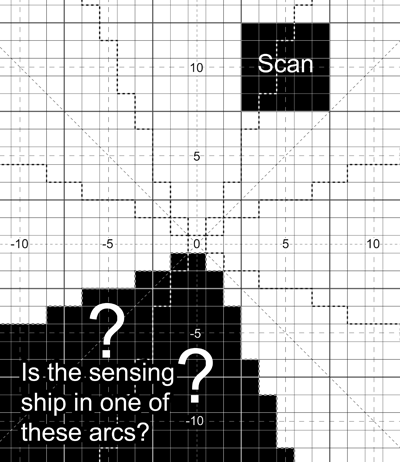
One problem with the old planet LOS rules was that it was entirely up to the sensing player to make sure the Scan was correct, it was also quite hard to do Scans near the edge of the LOS blocked arc because Scans are always square while the edges of arcs are always jaggy. The new rules let the sensing player put his Scans wherever he wants them ignoring planet LOS, he can even put them on top of the planet itself. It is then up to the other player to check LOS using the following procedure: Target player checks what arcs are touched by the Scan. He then asks the sensing player what opposite arc, if any, his sensing ship is in. The sensing player must tell him whether he is inside one of those opposite arcs or not and the target player can simply ignore the Scan for targets inside the opposite Scan. If the sensing player did a Scan including the planet all arcs are touched so the sensing player then must tell the player in what arc his sensing ship is in that case.

Sunfactor

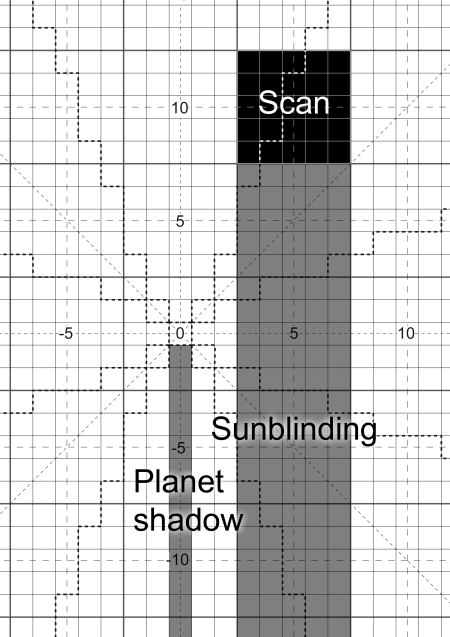
The Sunfactor represents the strong light, microwaves and neutrino emanating from the star. This factor is typically 6, +1 per orbit inside the hospitable zone, -1 per orbit outside the hospitable zone down to 0. Earth is 6, Mars is 5, Venus is 7 etc. The Sun factor is subtracted from Scans towards the sun as per the Sunblinding rules. Ships in the planetary shadow subtract the Sunfactor from their Visual(Hull). Optional: Streamlined and Airframe ships not in shadow and directly facing the sun subtract Sunfactor / 2, rounded up.

Sunblinding

Scans toward the sun are harder as he sensors are blinded by the sun. If your ship is below or south of your scan the Scan factor may be reduced by the Sunfactor. Mass scans ignore Sunblinding and any sensing ship in planetary shadow also avoid Sunblinding except Neutrino scans who suffer Sunblinding even when in shadow. Complicated?
Sunblinding subtract the Sunfactor from Scan.
Mass Scans ignore Sunblinding.
Neutrino Scans cannot use planetary shadow.

God must love vacuum, why else would he create so much of it?